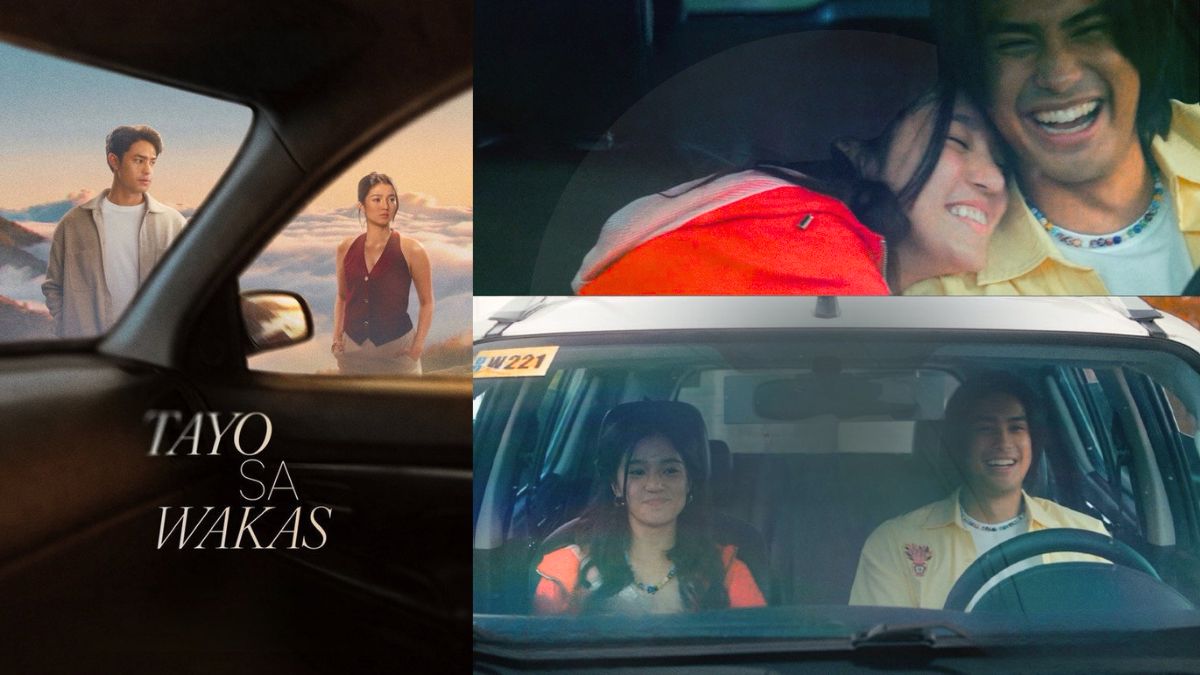
There’s a shift that happens in the second part of Tayo sa Wakas that cuts away at the charm of the film, making me question how the film approaches its themes, how it romanticizes a toxic character, and how it highlights his redemption arc. It’s a strong enough story at the beginning; Cathy Garcia-Sampana’s directing is dynamic and strong, while lead stars Donny Pangilinan and Belle Mariano show off their impressive on-screen chemistry. Mariano is capable of such immense range and nuanced acting, while Pangilinan shines in the heavier, more dramatic requirements of his role.
But Tayo sa Wakas is centered on Pangilinan’s character, Cisco. It’s really his film, with Mariano’s Cheska serving as the romantic lead, though her character’s point of view is withheld from the film – and there is a story element as to why. Cisco is the typical romantic lead presented as the forlorn lover who cannot move on from a breakup. Despite this framing, Mariano is just so good that her character’s presence is felt all throughout the film, even when she is off-screen, her presence lingers. It’s an amazing feat, Mariano really is a powerhouse.
The film, written by Vanessa R. Valdez, opens with a dizzying flashback of a break up between Cisco and Cheska. It’s hurtful. Cheska questions whether Cisco really deserves her love, and he walks away. We cut to the present, where Cisco has shaved his head. His family is scared for him as he insists on borrowing a car to visit someone. Not getting any help from his family, he goes to a friend (played by Joross Gamboa) who lends him a car and gives him advice. As Cisco is about to leave, Cheska appears and insists on going on a breakup trip. On the road, the two rehash their moments, the ones Cisco wants to hold on to and the ones Cheska wants to remind him of, when everything went wrong.

Through these flashbacks, we see a highly competitive Cisco who falls in love with the new intern, Cheska, who recognizes his ideas and talent even when others aren’t sure about them. We see the ways in which Cisco falls for her and makes his moves, and she falls too. It’s a classic romance story as the couple move in together. But in such close proximity, with work as a shared space, Cheska begins to rise and the highly competitive Cisco finds himself uncomfortable with his lover and protege’s growing success.

The first half of the movie has all the trappings of a romantic film, maybe even that of a rom-com (though every time it cuts back to the present, we know this won’t be a full-on comedy with a happy ending). Garcia-Sampana’s direction keeps the narrative busy and energetic. She even brings the two leads into the realm of the sensual, showing a lot of physical intimacy and skin. It looks grown-up, but it’s deceptive. It’s the lure of youth and young love, but the hard demands of the adult world will come calling, and they will find themselves unready.

But the truth is, Cheska is ready with the hard answers. Cisco, with all his privilege and bravado, is not. This is exactly where I felt more and more uncomfortable as the film progressed: Cisco is toxic. He fails at every turn when their relationship gets serious and when work gets in the way of their relationship. Throughout the film, we see only Cisco’s point of view. Garcia-Sampana’s direction tries to soften and humanize him, making the storytelling feel increadibly lopsided. Cheska’s perspective is just as important here, but the answer to that happens later in the film, leaving us entirely with Cisco’s road to redemption.

It’s not a pleasant movie to watch, though it starts out that way at the beginning. Mariano is magnificent all throughout, while Pangilinan seems more comfortable with the heavier, dramatic aspects of the narrative, feeling a bit out of place during the rom-com atmosphere of the film’s first half. There is a serious dramatic actor in Pangilinan, and I hope they give him more roles that play to his strengths. Yes, he’s attractive and his chemistry with Mariano is electric, but he doesn’t seem as natural in the kilig scenes as he is in the more emotionally demanding ones.
Sitting through this film became difficult after a while. So many movies have put toxic men and their high expectations of women in relationship into the spotlight, but they always seem to get their hard lessons served right up to them. I can recall Never Not Love You, Un/Happy For You, and just the recent The Loved One. In those films, the woman’s perspective served as the balance that kept the narrative from romanticize the man’s toxic behaviour. As good as Pangilinan is here, not even Marianos’ fantastic performance can fully balance this narrative’s gaps.
My Rating: 2.5 Stars

Tayo sa Wakas is a beautifully acted drama where the undeniable, explosive chemistry of Donny Pangilinan and Belle Mariano makes the journey worth taking. Check your local showtimes and watch it on the big screen this weekend!
Leave a Reply
You must be logged in to post a comment.