Author: Wanggo Gallaga

  • Movie Review: A Straightforward Horror Film, “Other Mommy” Shines Through the Performances of Jessica Chastain and Arabella Olivia Clark

    Movie Review: A Straightforward Horror Film, “Other Mommy” Shines Through the Performances of Jessica Chastain and Arabella Olivia Clark

    From the very first ten minutes of Other Mommy, we are immediately thrust into the terror. It’s a straightforward horror film that spends no time establishing the first act. Right from the get-go, we meet the titular Other Mommy, and the thrills and frights begin. It’s a really novel way to start a scary movie, wasting no time and going straight into the action. Director Rob Savage and screenwriter Nathan Elston (adapting Josh Malerman’s novel Incidents Around the House) get everything moving right away and it’s a wildly entertaining ride.

    The story centers on seven-year-old Bela (Arabella Olivia Clark), who can tell something is not right with her mom and dad, Ursula (Jessica Chastain) and Russell (Jay Duplass). Ursula seems to be the more career-oriented parent, while Russell is the carefree, fun-loving stay-at-home dad. Luckily, or perhaps unfortunately, for Bela, she has a friend: a supernatural entity she calls Other Mommy. Other Mommy wants something from Bela; she wants permission to “be in her heart.” Within the first ten minutes of the film, the entity commits her first violent act and from then on, forcing Ursula and Russell to do whatever it takes to protect their daughter while guarding a dark secret of their own.
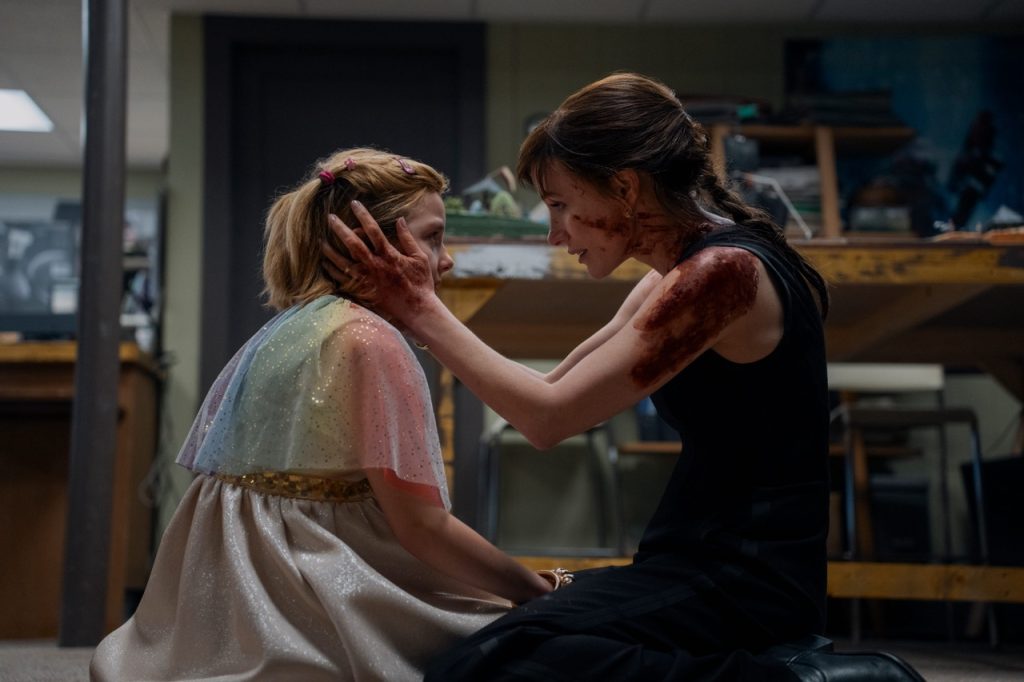
    Other Mommy 2599 D020 00216RC 1
    Arabella Olivia Clark (Bela) and Jessica Chastain (Ursula) in ‘Other Mommy’. (Courtesy of Universal Pictures)

    This film cuts away from many traditional narrative beats seen in movies involving hauntings and children. Ursula and Russell immediately believe Bela. They never question what it is that they see, nor is there a plotline where the parents refuse to believe Bela or what they see. In fact, they remain quite level-headed about it considering they just experienced a paranormal event. It feels deeply refreshing to watch a horror film where the main characters make practical, sensible decisions. 

    But how do you stop an entity that can shape-shift and move matter at will?

    Savage, alongside cinematographer Lowell A. Meyer and editor John Cutler, manipulates the mise-en-scene and mise-en-shot so that every camera movement and every jump cut becomes a potentially frightening moment. The film is not afraid to use jump scares, but they never feel cheap or unwarranted. Other Mommy is a playful demon. Surprise is part of its strategy. For the audience, though, it keeps you firmly on the edge of your seat.
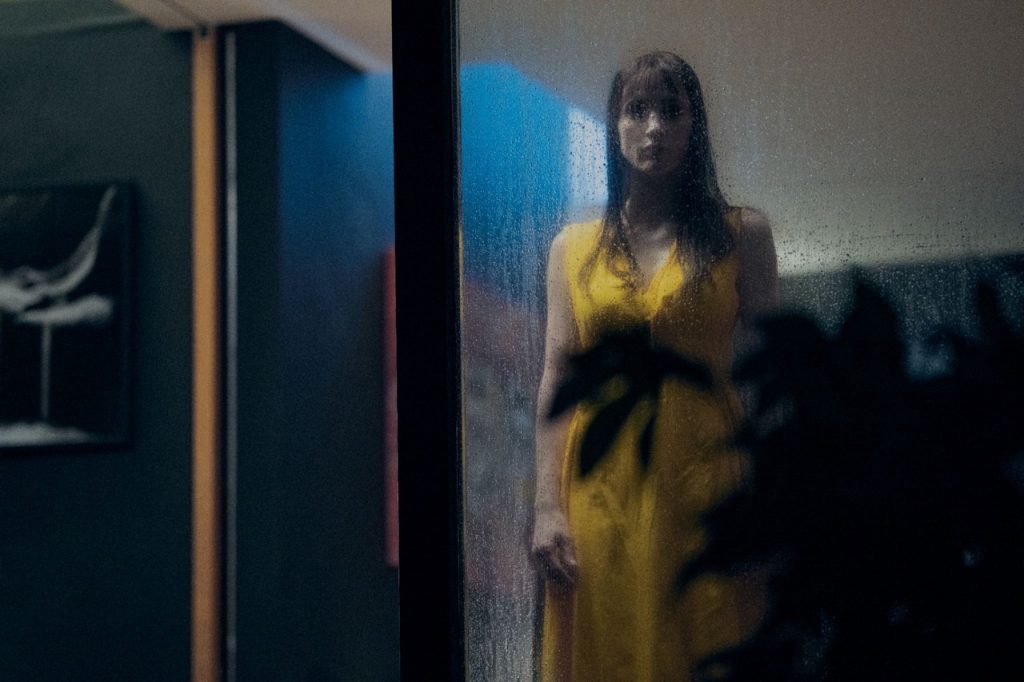
    Other Mommy
    Jessica Chastain (Ursula) in ‘Other Mommy’. (Courtesy of Universal Pictures)

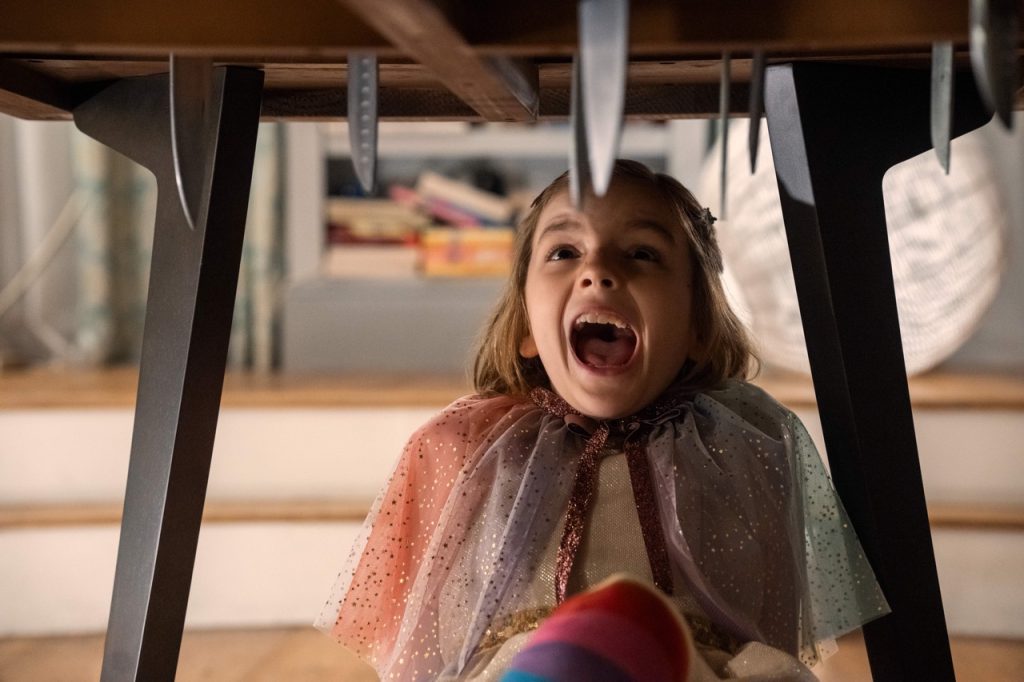
    While Chastain gets top billing – playing both Ursula and the primary form of Other Mommy – she earns every bit of it. She keeps the two characters distinctly separate, but when the music turns up and you realize you are looking at Other Mommy rather than Ursula, Chastain uses her entire physicality to embody the strain required for the entity to assume this human form. As Bela says early in the film, “she’s still new” at this. Chastain uses this raw physical tension to fully show this and it is remarkable to watch. 
    Other Mommy
    Arabella Olivia Clark (Bela) in ‘Other Mommy’. (Courtesy of Universal Pictures)

    But this film ultimately belongs to Clark. The young actress carries the movie with her delicate portrayal of childhood innocence and being overwhelmed by all that is happening. When she observes her surroundings, she knows exactly the full context of what she is seeing. We understand the entire story through her eyes. It’s an incredible performance from such a young actor and it helps ground the film and gives the audience someone truly worth rooting for.

    My only issue is the usual classic American approach to horror. The protagonists feel compelled to fight back, and American exceptionalism comes into play, and it undercuts the fear that is established. It is such an American response that if something is in your way, you have to get rid of it – kill it, even – regardless of what it is. Having watched plenty of Asian horror, where characters simply focus on surviving, Americans have to fight back, and it comes off as arrogant. At the same time, as good as the CGI can be, the overuse of it takes us away from the fear. Fortunately, Cutler is good at keeping the visuals very brief, cutting away quickly before the audience can linger on the CGI effects. Still, by the second half, some of the initial magic established at the beginning is gone.

    There is a lot to enjoy in Other Mommy, and it will get the crowd screaming in fright. While it grows a little bit corny by the end, the film delivers enough suspense and thrills to make it well worth the price of the ticket.

    My Rating: 4 Stars

    stars 4 0


    Ready to meet Other Mommy? Catch Other Mommy in theaters now, just make sure you know who’s really tucked in at night. Click here for showtimes.
  • Movie Review: Blowing the Whistle: A Review of “The Social Reckoning”

    Movie Review: Blowing the Whistle: A Review of “The Social Reckoning”

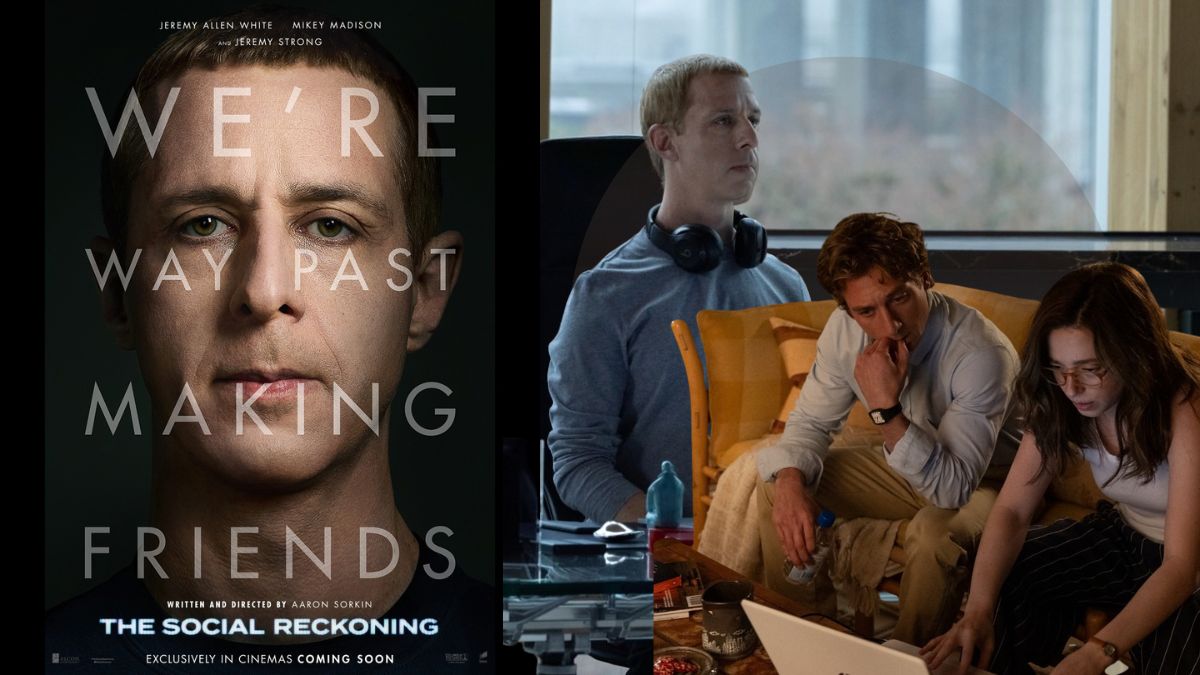
    A lot has happened since director David Fincher and screenwriter Aaron Sorkin released The Social Network 16 years ago. The social media landscape has shifted dramatically, and Sorkin was right to feel that there was more than enough material for a sequel. Written and directed by Sorkin, The Social Reckoning functions as a standalone sequel defined as a legal thriller. It follows a whistleblower exposing Facebook’s internal policies, detailing how they pose a danger to its users, and leading up to the January 6 Capitol insurrection.

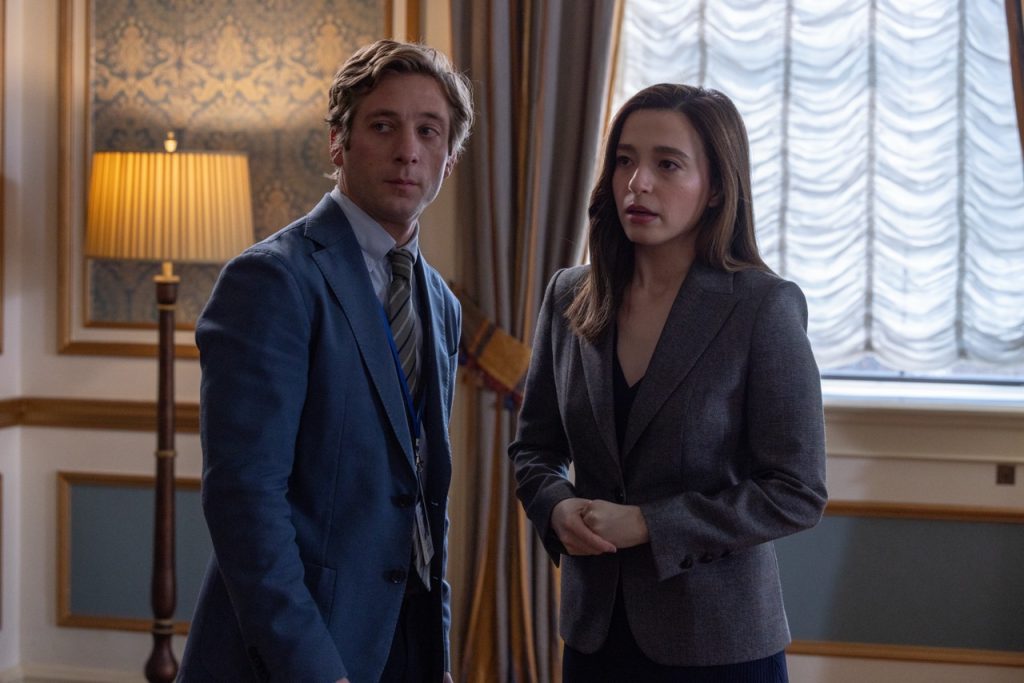
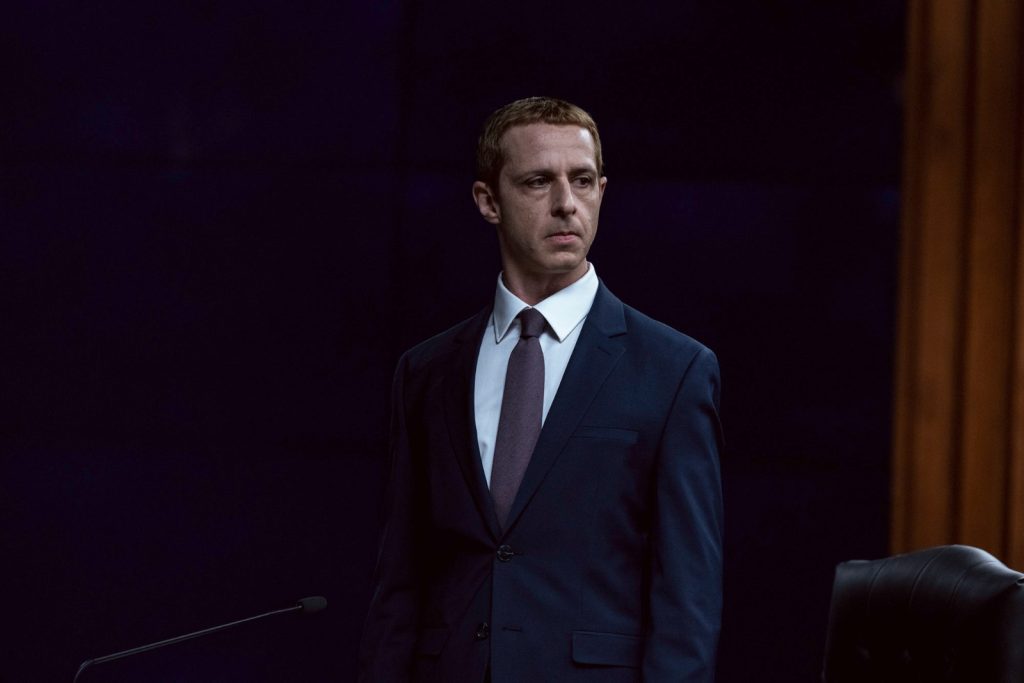
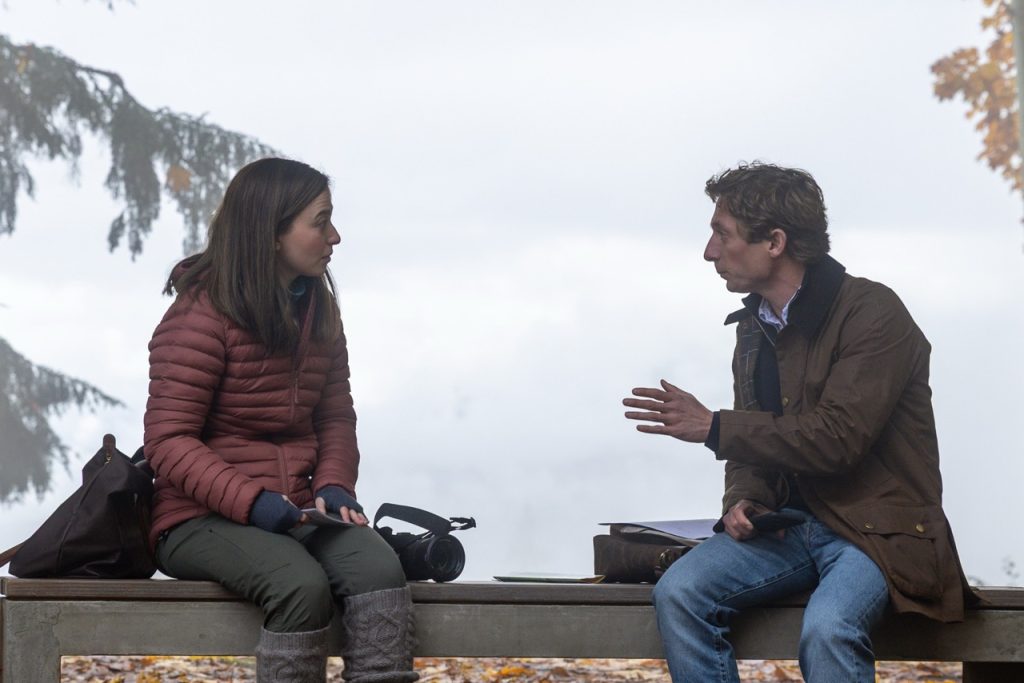
    We follow real-life whistleblower Frances Haugen (played by Mikey Madison) as she is contacted by investigative reporter Jeff Horwitz (Jeremy Allan White), for an interview. Frances, a data engineer who is part of a team that is tasked to create safeguards for Facebook’s social and community interactions, has made several concerning observations. She has been trying to alert management, but no one seems willing to listen. So, she turns to Jeff so her voice can finally be heard. This leads to the discovery that the algorithm of the social media site with over 1.2 billion users has led to the radicalization of many of its users. Running parallel to her story, set three years later, Mark Zuckerberg (Jeremy Strong) prepares for a tense congressional inquiry as the reports begin to surface.

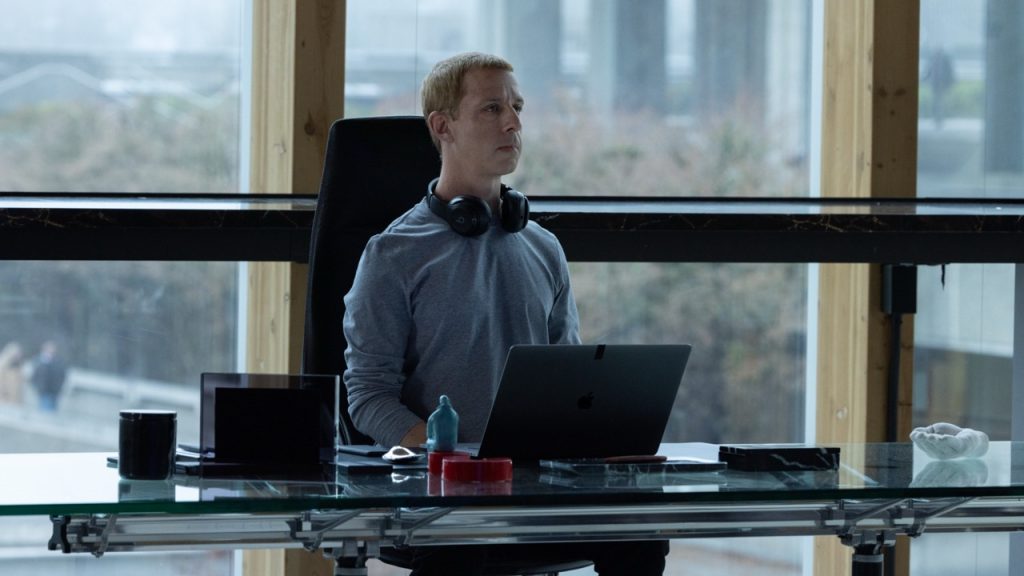
    The Social Reckoning DF 01240 c
    The Social Reckoning | Photo courtesy of Columbia Pictures

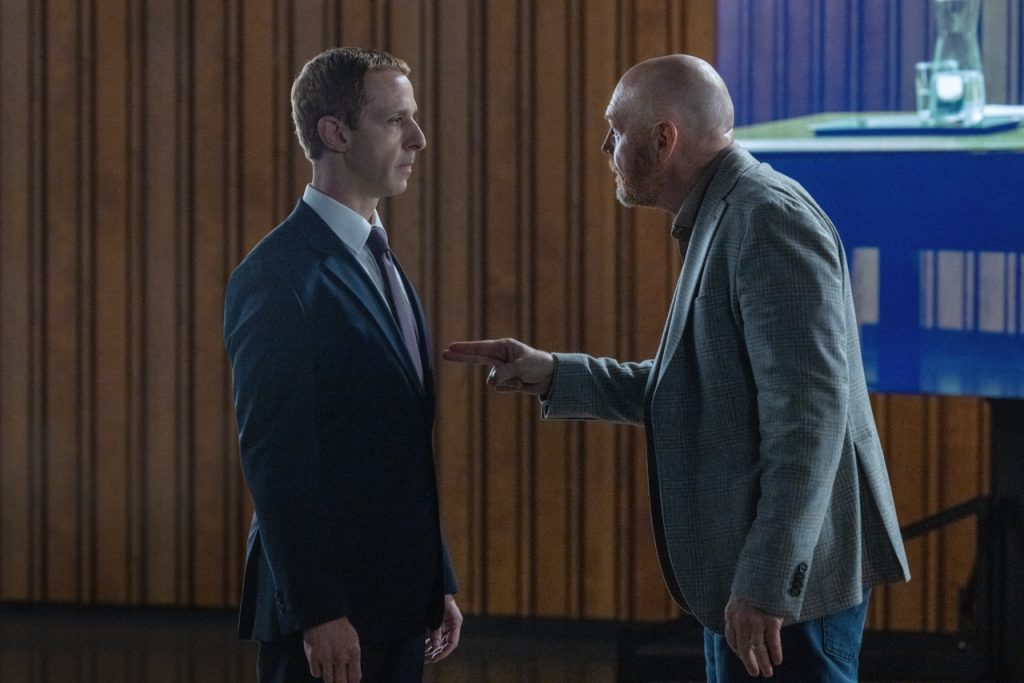
    The film jumps between two separate timelines. One is independent of the other. Mark Zuckerberg seems unaware of what is happening in the past – where a loyal employee who loves the goal and ambition of Facebook, is talking to a reporter because the management doesn’t seem to care that the company is radicalizing its users. The use of the timeline jump emphasizes the coldness with which Zuckerberg runs his company and that the people above have no idea or care about what is happening on the ground. From the way Zuckerberg is failing the inquiry preparations, we can tell that all he cares about is the bottom line: profit.

    The Social Reckoning DF 07685 r
    The Social Reckoning | Photo courtesy of Columbia Pictures

    It also helps that Jeremy Strong plays the older Zuckerberg almost like a robot: emotionless, cold, and guarded. He trusts no one. He is used to getting his way and treats everyone around him like they are there as subordinates. It is a calculated portrayal meant to make him feel culpable of all the things the film is blaming him for, and it does its job of creating a frightening villain for this take on the narrative.

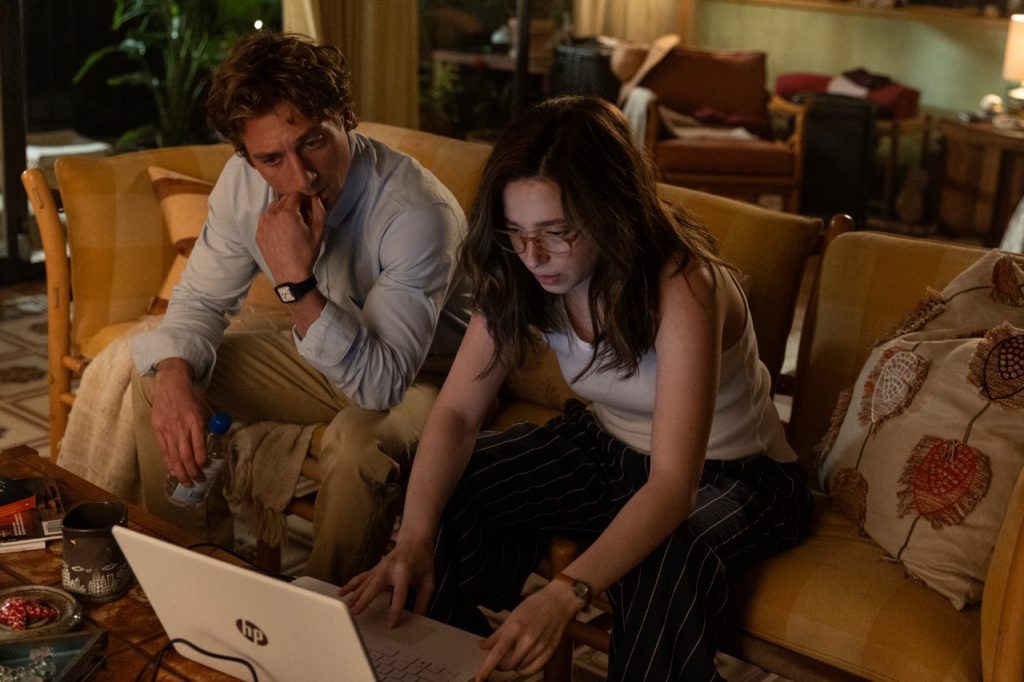
    The Social Reckoning DF 07132 1
    The Social Reckoning | Photo courtesy of Columbia Pictures

    While Jeremy Allen White does an amazing job as Jeff Horwitz, cool and composed as he goes about his job; he’s a real pro, not investing in the people and keeping his distance because he knows this can get ugly. But the few moments that he can show that he cares, it’s so evident. But the real heavy lifting comes from Academy Award winner Mikey Madison, who is at the center of all of this. She’s the spark that changes everything. Portraying Haugen as socially awkward and without a filter, Madison embodies someone who is accidentally funny yet completely relatable. She serves as the heart and soul of this film, and she carries it without breaking a sweat.

    The Social Reckoning DF 03422
    The Social Reckoning | Photo courtesy of Columbia Pictures

    These great performances ground the film. True to Aaron Sorkin’s signature style, the dialogue comes packed with rapid-fire technical jargon line delivery, but you have to take it on faith that it will all make sense later. His world is real because he doesn’t dumb it down for the audience, he never sacrifices his world building for the audience who doesn’t pay attention. Instead, he writes his scripts in a way that allows a moment for everything to be explained and to be clear. Halfway through the movie, we understand what is at stake and there’s a lot that is at stake here.

    The Social Reckoning
    The Social Reckoning | Photo courtesy of Columbia Pictures

    This is a movie that encourages us to start asking questions about what we are exactly seeing online, how much of it is random and how much of it is intentional. It informs us that these social media sites are designed to keep us engaged, regardless of the negative effects they may have on our lives. Their goal is to make a profit out of this at the expense of our mental health and the integrity of our social fabric. 

    The Social Reckoning
    The Social Reckoning | Photo courtesy of Columbia Pictures

    I really hope people get to see this film. If not to truly understand how insidious these social media platforms are doing to our society, then at least to witness the fantastic performances from its cast. Mikey Madison delivers a standout lead performance, and Betty Gilpin makes full use of her limited scenes to stand out in every scene as the editor of The Wall Street Journal. It’s a well-crafted film that hits all the right notes and delivers a hopeful ending, that is only undercut by the reality of what continues to happen today.

    My Rating: 4 Stars

    stars 4 0


    Powerful, timely, and driven by incredible performances from Mikey Madison and Jeremy Allen White, The Social Reckoning is a sharp, necessary piece of cinema that demands to be seen, not just for its outstanding lead performances, but for the essential questions it forces us to ask about the digital world we live in. Don’t skip this one. Check showtimes here.

  • Theater Review: Baring It All in “Last Dance – Hubo’t Hubad”

    Theater Review: Baring It All in “Last Dance – Hubo’t Hubad”

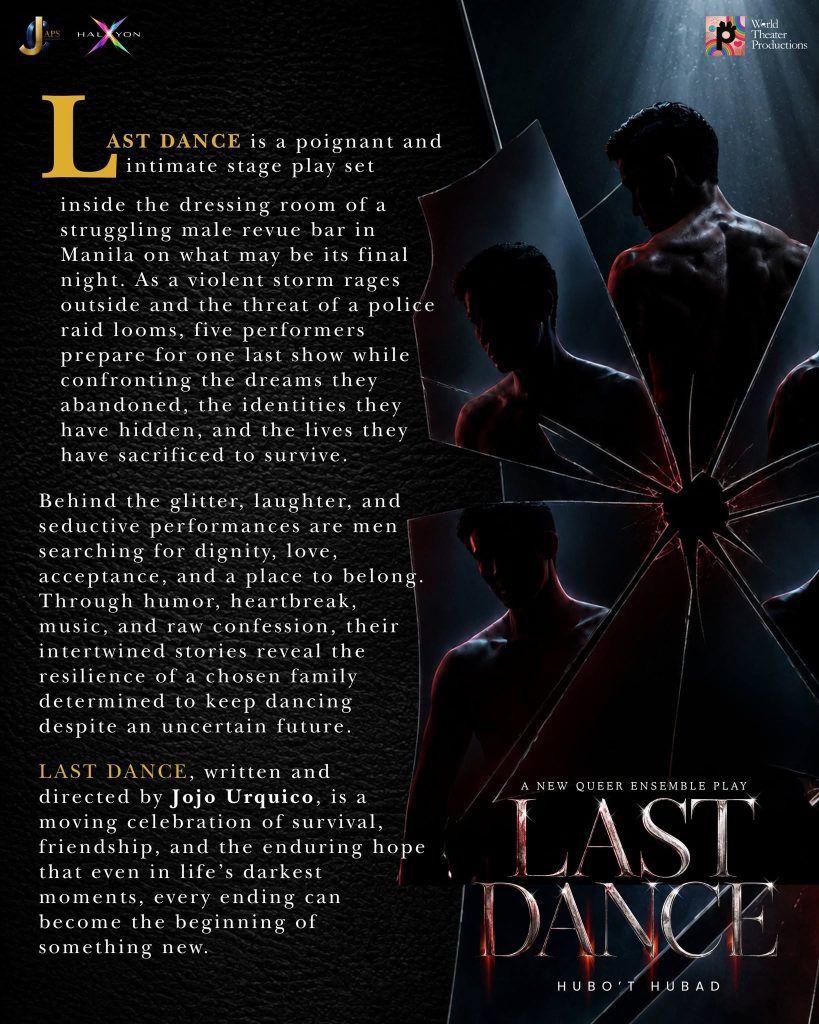
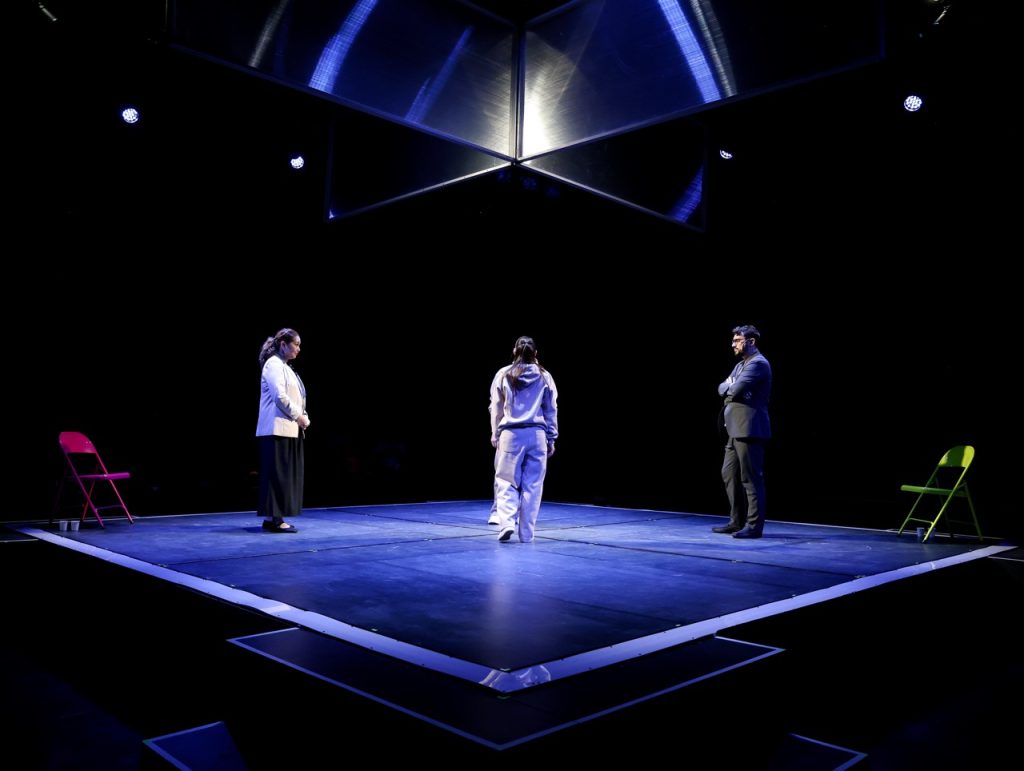
    It seems fitting that Jojo Urquico’s brand new play, “Last Dance – Hubo’t Hubad,” would run at a club in Poblacion. Halxyon Club in Poblacion, Makati transforms into a theater with a stage in thrust format for this story about male go-go dancers at a drag club. When a raid stops the show right as it begins, five male dancers share their stories with the newest member of the team. Halxyon Club gives an authentic sense of realism to the setting, though it is suggested to come prepared and wear something warm as the air conditioning is really cold and to get a seat near the front as the seats are monoblocs and you might not see what’s happening on stage if taller audience are sitting in front of you.

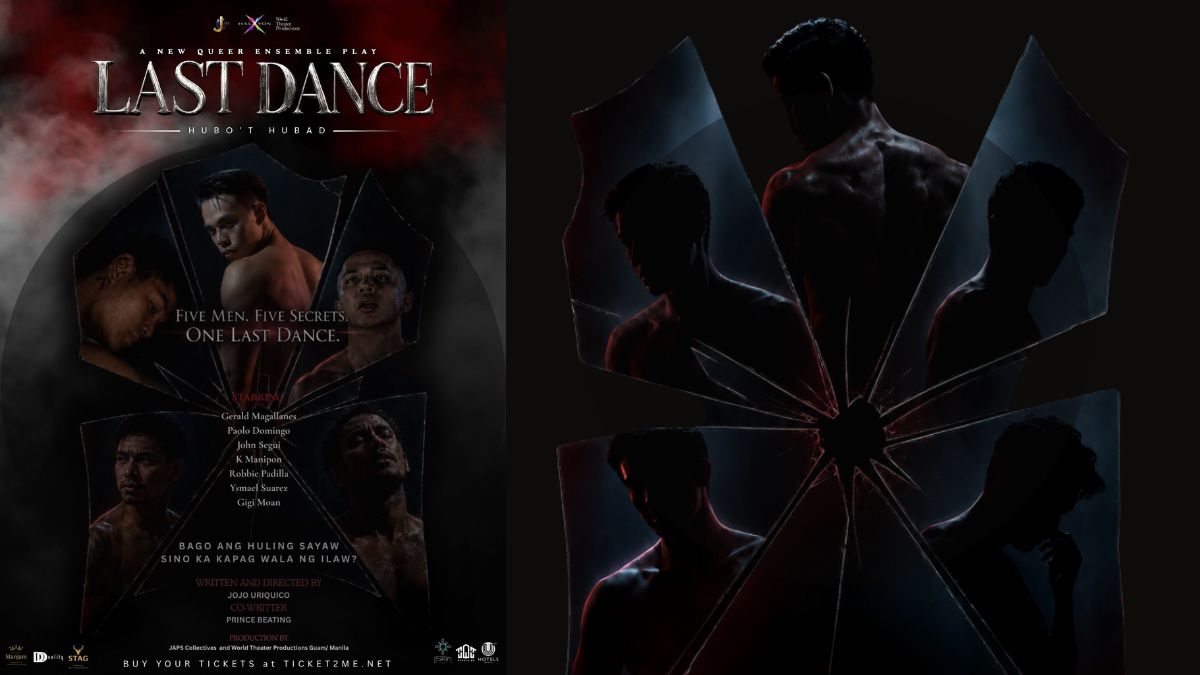
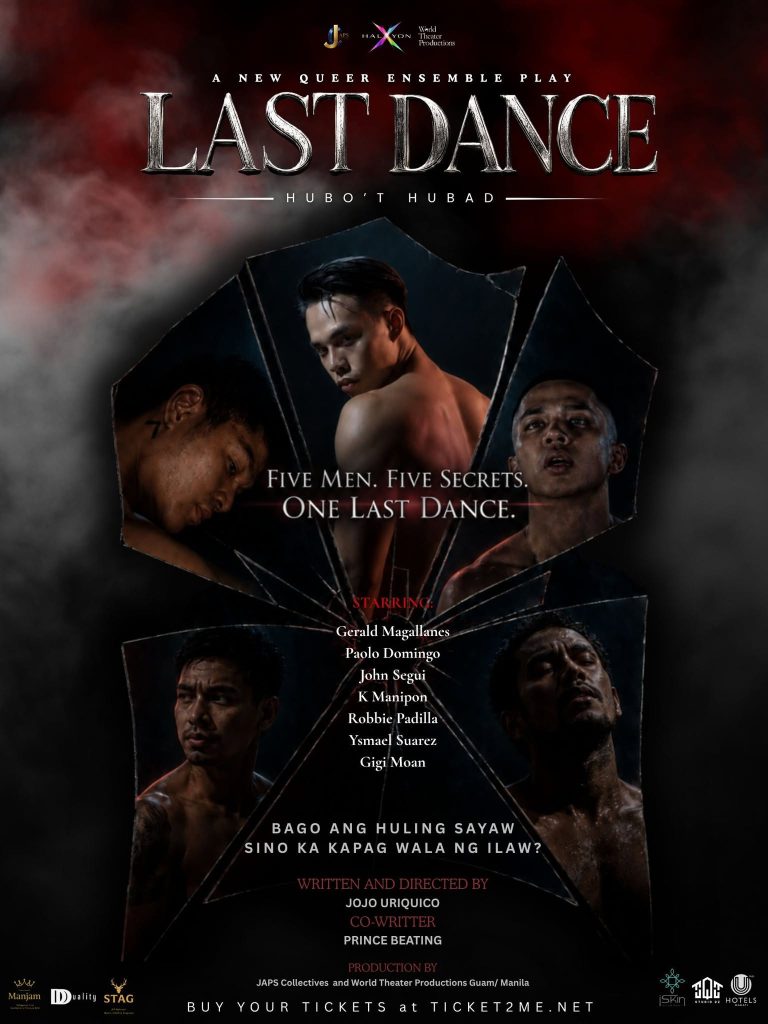
    Last Dance Hubot Hubad Poster
    Last Dance – Hubo’t Hubad | Image Source: Halxyon Club FB Page

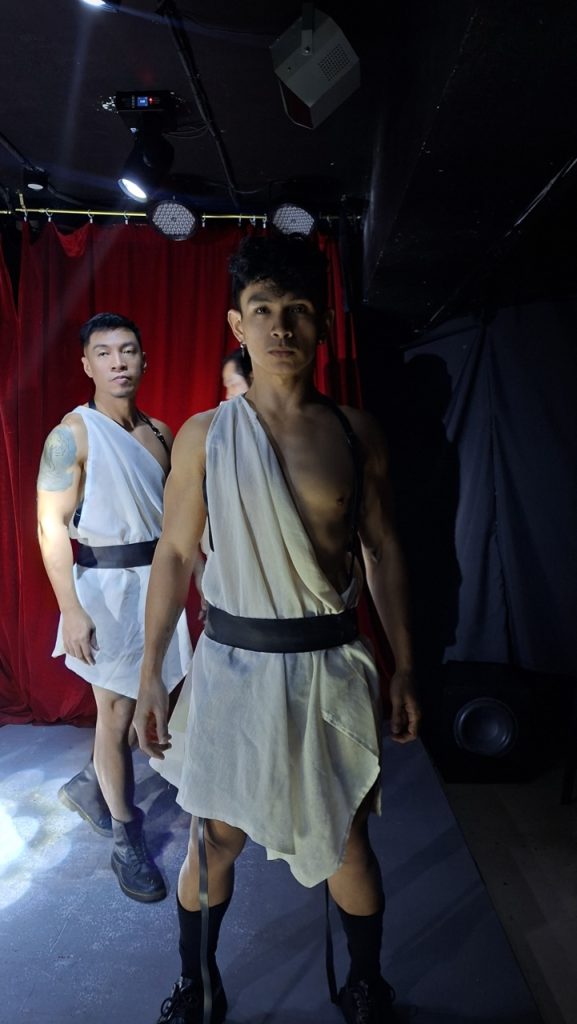
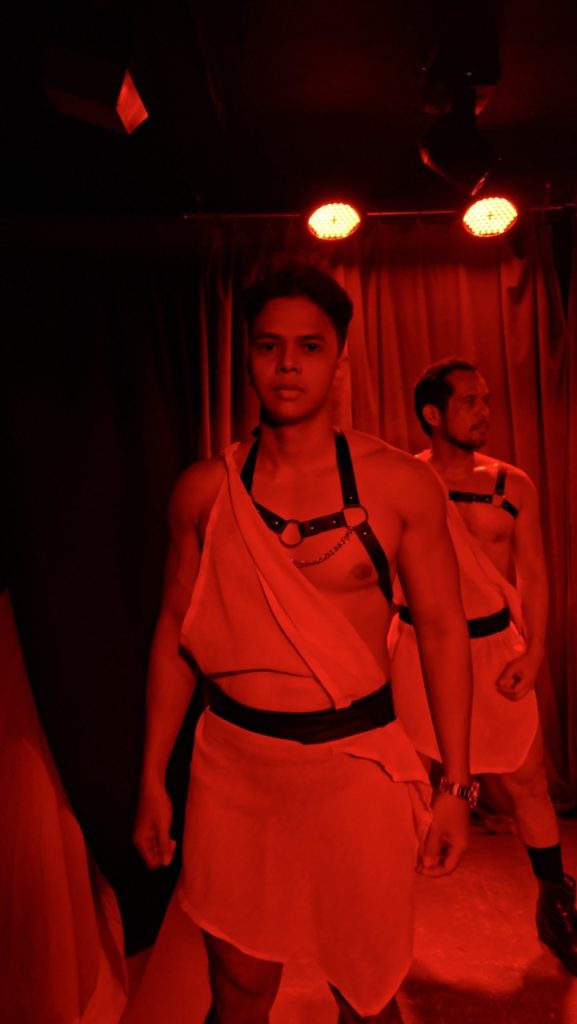
    And while the play opens with a drag performance, Fewsha Umb and Lexi Era perform in amazing outfits, the five actors takes the stage: Gerald Magallanes as Ace, Paolo Domingo as Jay, John Segui as Dodong, Kriszan Manipon as Mark, and Robbie Padilla as Rafa (with alternates Ysmael Suarez for Dodong and Lance Cabradilla for Ace). They deliver a striptease and provocative dance in Greek-inspired togas, later shedding them for nothing but black briefs and harnesses. When the raid happens, the men rush to their dressing room, where Mama Lou (played by Jem-jem Ria Lopez) assures them that it was a false alarm, though it would be prudent to close for the night.

    Last Dance - Hubo't Hubad
    Last Dance – Hubo’t Hubad | Photos courtesy of the JAPSCollectives Photo Team

    Left with nothing to do, the men begin to dress while questioning Jay, the youngest and newest member of the group. 

    Running approximately 90 minutes, the play takes “baring it all” to the next level. While catching their breath, the five actors are practically naked, with only their briefs keeping them from full nudity. But it is the stories they share that renders them vulnerable. The advice and insights woven into their individual stories expose each character naked in an emotional way. Every story paints a picture of desperate need, revealing this job as the only way out for these characters. 

    Throughout their sharing, they truly bare it all, dressing down and then going into casual clothes. The night on stage is over, but for some of these characters, it has just begun.

    Of the cast, Magallanes is the only one with solid theatrical experience, and it shows. There’s a natural delivery of Ace’s rough and prickly exterior. His story is one of abandonment and a tough armor, one that is gruff and grim, serving as a safety mechanism. Yet Magallanes also subtly reveals Ace’s softer side in quiet moments. While others are deliver their stories, his expressions betray his character’s empathy. While others are doing their monologues, he’s still in character, reacting, keeping busy. He’s making it all feel real along with Manipon, whose portrayal of Mark has a job, but it isn’t enough to pay the bills and so he does this to provide for his family. There’s a sincerity to his portrayal that works well alongside Magallanes’.

    Last Dance – Hubot Hubad 20260928 104853
    Last Dance – Hubo’t Hubad | Photos courtesy of the JAPSCollectives Photo Team

    The rest of the ensemble is still finding its balance. Domingo captures Jay’s exuberance and innocence, but his performance feels timed. It feels forcibly pushed out rather than coming from a genuine place. There’s an old school theater style emanating from his line delivery that feels off when matched with the others who take a more naturalistic approach. Segui and Padilla are hitting their cues, but Sequi often feels rehearsed, while Padilla still needs to work on projection. He’s in the moment but his voice and emotions fail to carry beyond the edge of the stage. 

    I thought it was quite clever, to have the characters begin practically unclothed, only to dress in front of the audience as they prepare to head home, while sharing their personal stories that leave them even more vulnerable than being naked. The play asks us to truly see them – not just their bodies, but their humanity. This marks Jojo Urquico’s first foray into playwriting, and it shows in places. Some of the stories could be further fleshed out, and the dialogue could be drawn out a little further so the characters can build to their emotional peaks gradually rather than abruptly. Yet there is a cleverness in the direction, evident in how seamlessly the stage transforms from a club into a dressing room in a quick blackout. The blocking within that tiny space, as the actors shift seats, move toward lockers to change while one actor delivers a monologue feels entirely organic and natural.

    Last Dance - Hubo't Hubad
    Last Dance – Hubo’t Hubad | Image Source: JAPSCollectives FB Page

    This is not a new story, but it is one that will continue to be told until we can fix the system so that no one has to do this out of desperation, or at the very least, until we can afford to give them dignity in the profession. After all, people do come to watch these kinds of shows. They are entertainers, and this is a profession. “Last Dance – Hubo’t Hubad” pulls back the curtain, revealing what lies behind the stage.

    My Rating: 3 Stars

    stars 3 0

    Five men. Five secrets. One last dance. Don’t miss Jojo Urquico’s Last Dance – Hubo’t Hubad as it transforms Halxyon Club in Poblacion, Makati into a stage for raw human vulnerability. The show runs through October 29, tickets available at Ticket2Me.

  • My Favorite Works from the CinePanalo Student Short Films

    My Favorite Works from the CinePanalo Student Short Films

    With 19 entries in a competition alone, a huge number of short films in any festival plus a separate Panoramal section, CinePanalo Film Festival is making a big move to champion new voices in Philippine filmmaking landscape. The lineup was selected by a committee reviewing the screenplays before selecting the entries who would receive sizable production grants to their works. While a few films fell short of their scripts’ full potential, many were able to bring their visions to life.

    But even if some of the films didn’t fully achieve the vision laid out during conceptualization, the mere fact that they finished and premiered their works in a major festival like CinePanalo is a wonderful opportunity for them to grow as filmmakers and do even better in their next outing. 

    While some films are still figuring out their voices, certain talents shine through instantly, like Jonalyn Mateo’s lead turn in “Ang Huling Banlaw ni Susan,” Kaleb Ong’s supporting role in “When Heaven Inched Towards the Earth,” or the VFX team of “Teks Battle: Shoot Pati Pato!”

    Of the 19 entries, these are the ones that stood out to me:

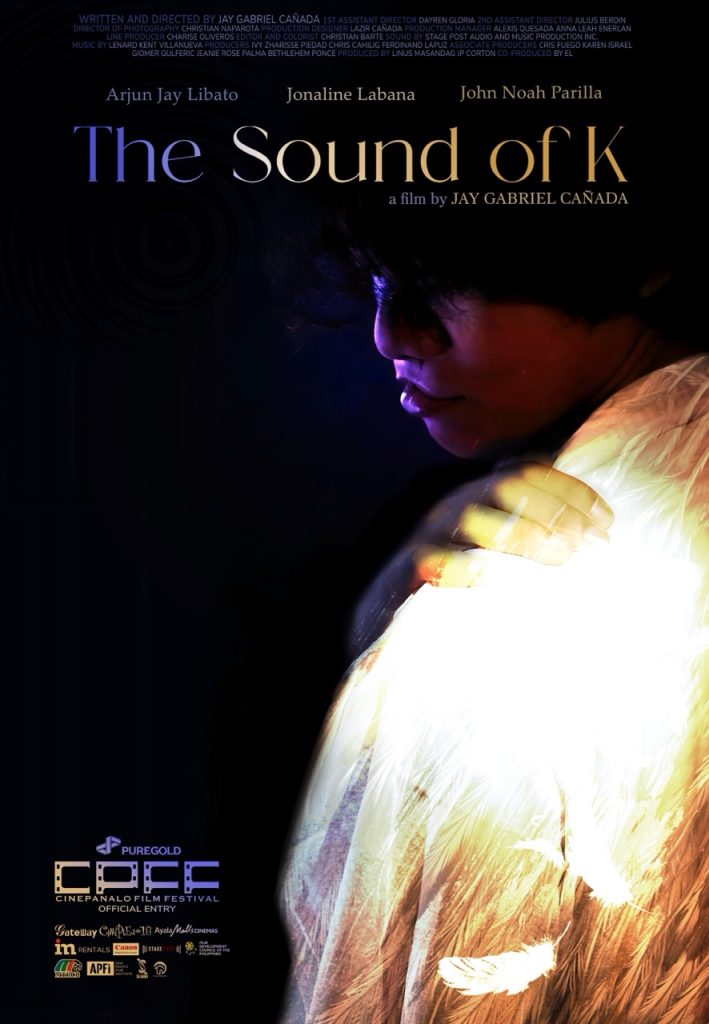
    CinePanalo The Sound of K
    Puregold CinePanalo Film Festival 2026

    The Sound of K

    Directed by Jay Gabriel Canada (Visayas State University)

    Raw in its execution, there is poetry in the script that plays out while the actor (who is also the director) showcases a wonderfully nuanced performance that truly captures the anxieties and fears of someone with a speech impediment. There is a strong indie feel to the whole production that amplifies the sincerity of the piece, making it stand out to me.

    CinePanalo Alumahan
    Puregold CinePanalo Film Festival 2026

    Alumahan

    Directed by Christian Melvin Arejola (Polytechnic University of the Philippines)

    A dark, very quiet coming-of-age story about a young boy searching for belonging in a seaside town. There is a constant state of danger that lies just underneath as the young boy joins a gang. It is a tight narrative that packs a punch and features some strong performances from its cast.

    CinePanalo Pulis Dunggab
    Puregold CinePanalo Film Festival 2026

    Pulis Dunggab

    Directed by Maxine Dela Bajan (iAcademy – Cebu)

    I was so involved with the direction, editing, and writing of this story about a kid’s game that turns frighteningly real. There is genuine love and respect for the locale and the milieu, and the characters really shine with strong performances by the two leads, Van Jordan Gacayan and Elj Seth Tababa. There is such good control here of the film elements that the whole movie felt truly polished.

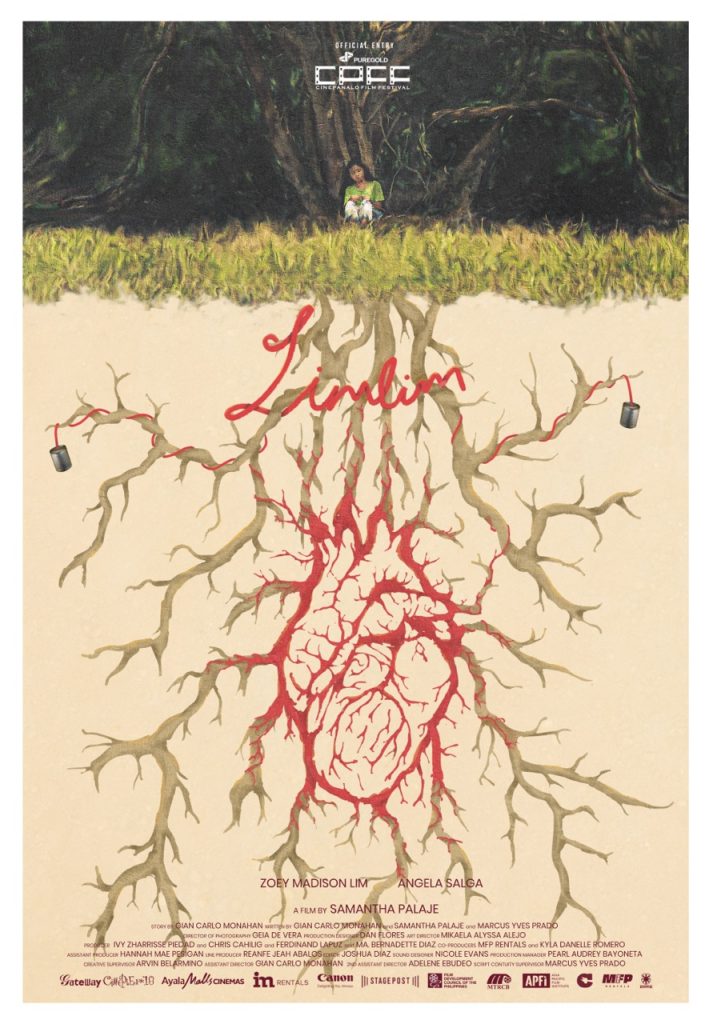
    CinePanalo Limlim
    Puregold CinePanalo Film Festival 2026

    Limlim

    Directed by Samantha Beatriz Acoja Palaje (St. Dominic College of Asia)

    Another example of a strong short film where the director had full control of the film elements, “Limlim” is a haunting story of a young girl with a dark history. The film tackles a challenging and very relevant issue with quiet grace and careful restraint.

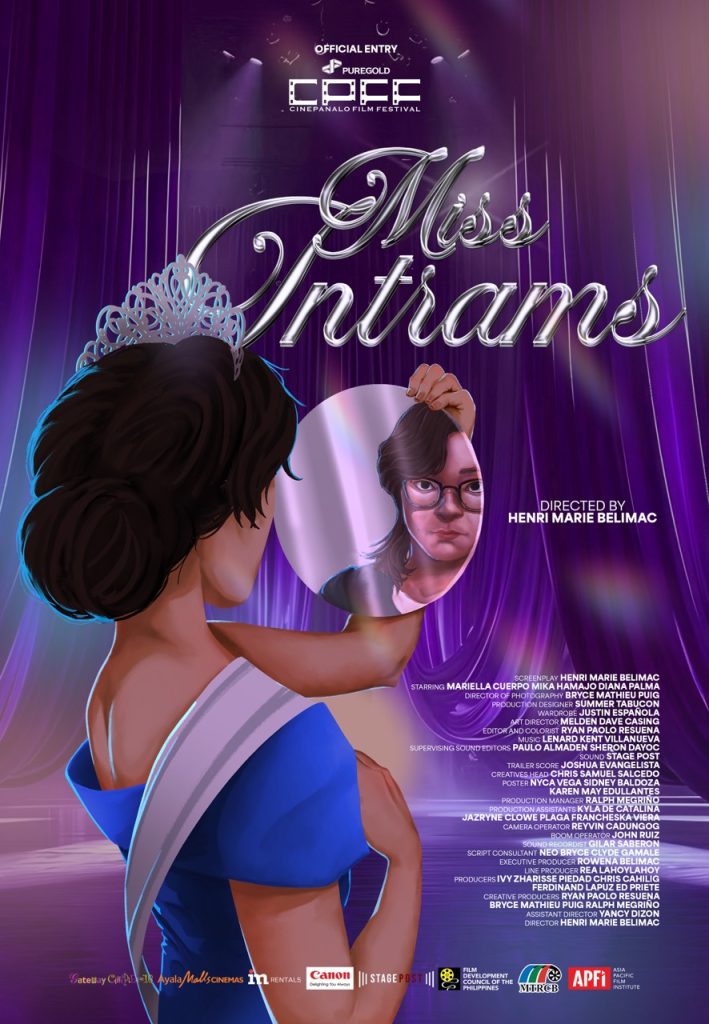
    CinePanalo Miss Intrams
    Puregold CinePanalo Film Festival 2026

    Miss Intrams

    Directed by Henri Marie Belimac (University of the Philippines – Mindanao)

    Though a bit overwritten, Belimac’s “Miss Intrams” is an insightful exploration of a queer trans man’s understanding of hisself through joining a pageant. Belimac’s direction shows a good grasp of mainstream aesthetics and filmmaking, with strong performances from its cast and a great use of music. 

    CinePanalo Nang Matakasan Ang Tagay
    Puregold CinePanalo Film Festival 2026

    Nang Matakasan Ang Tagay

    Directed by Giancarlo Santiago (University of the Philippines – Diliman)

    Santiago’s film navigates the inner struggles of a marino who is about to leave for another deployment while he spends time with his son and attends drinking sessions with his friends. The film explores toxic masculinity and the layers underneath. It is another entry where the rawness of the filmmaking amplifies the sincerity of the piece, and its almost-cliched ending brought me to tears with just the right amount of heart.

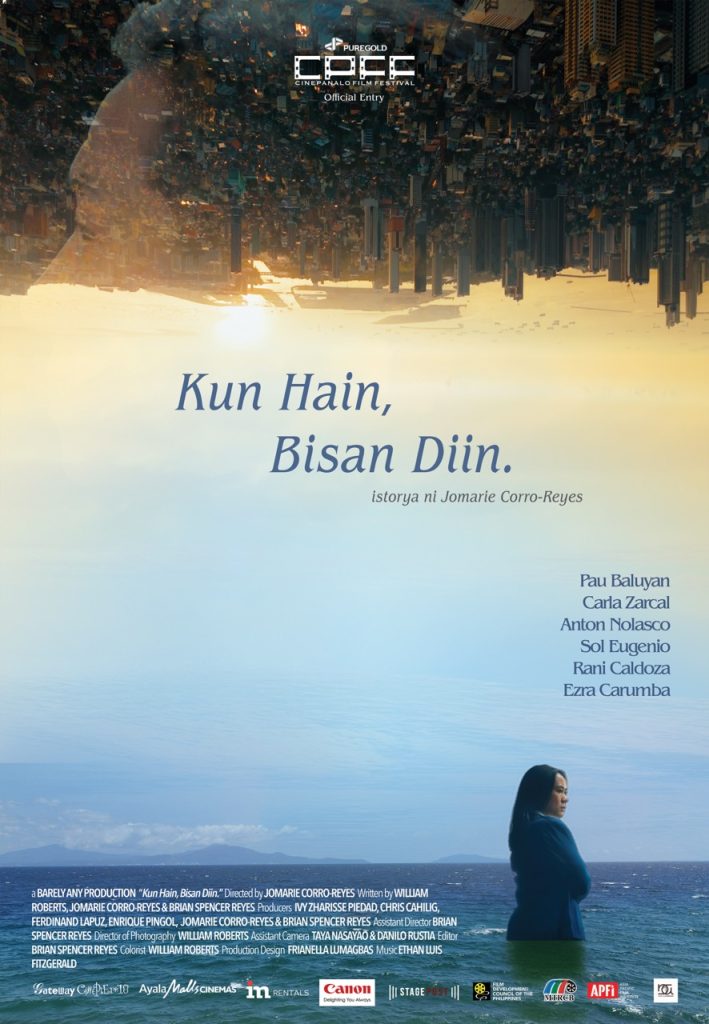
    CinePanalo Kun Hain, Bisan Diin
    Puregold CinePanalo Film Festival 2026

    Kun Hain, Bisan Diin

    Directed by Jomarie Reyes (University of the Philippines – Diliman)

    A very polished work about a woman who embarks on a journey to find her activist mother in Samar before her wedding, the film makes excellent use of editing to convey the intense history of the complex relationship between mother and daughter. It is a smart film that shows great restraint from Reyes, who pulls back from the drama to let the story speak for itself.

  • THEATER REVIEW: Love and Other Drugs: A Review of CAST’s “The Effect” by Lucy Prebble

    THEATER REVIEW: Love and Other Drugs: A Review of CAST’s “The Effect” by Lucy Prebble

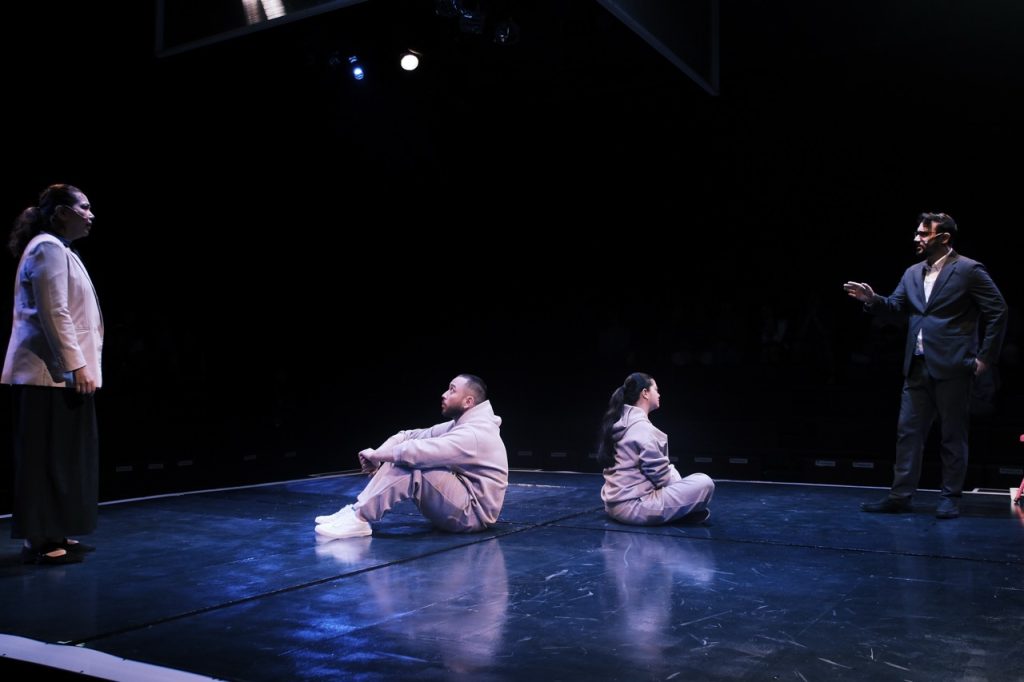
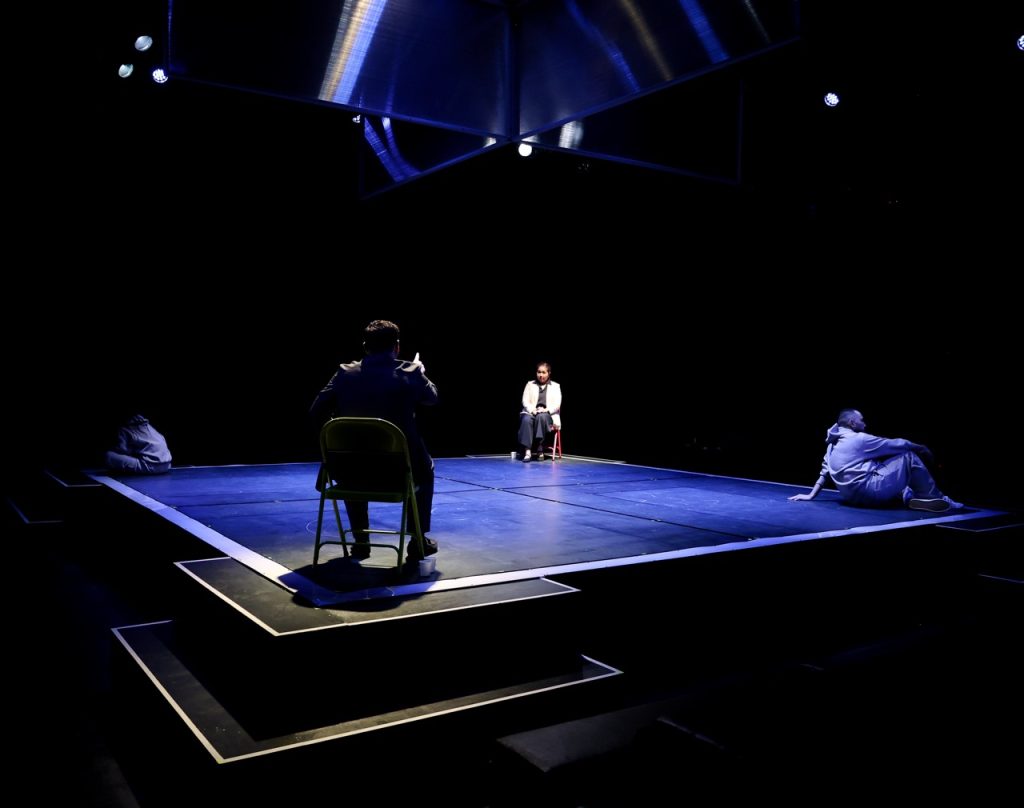
    At the Doreen Black Box Theater in Arete, Ateneo, the stage design for Lucy Prebble’s The Effect, as imagined by director Sarah Facuri and set designer D. Cortezano places the stage right at the center, completely surrounded by the audience. On the raised platform sit two chairs, tucked into opposite corners of each other. The moment I saw it, I thought of a boxing ring sans ropes. I knew nothing coming into this play, having missed the successful staged reading of CAST which was the reason it was mounted as a full production. But the armbands handed to us with our tickets were fashioned like the hospital identification tags, which already prompted us for what was to follow.

    The Effect
    The Effect | Photos Courtesy of CAST PH by Myra Ho

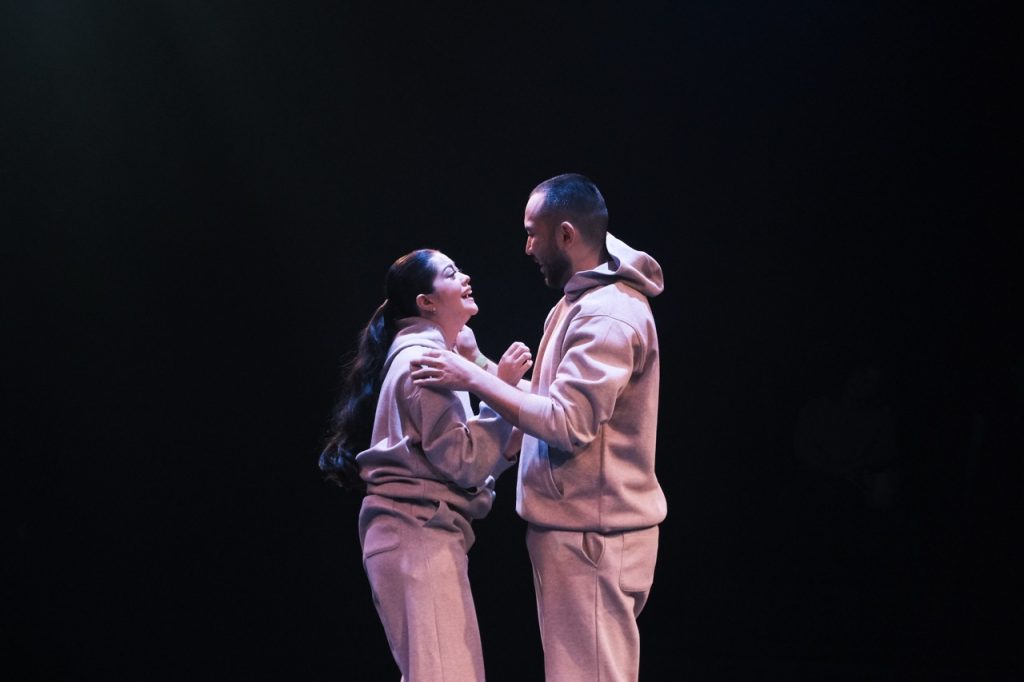
    The Effect follows Connie and Tristan, played by Sue Ramirez and Brian Sy, two volunteers who have joined a clinical trial for a new antidepressant. They have to stay in a facility throughout the experiment with no contact with the outside world. They are monitored by Dr. Lorna James (Cathy Azanza-Dy), who reports her findings to Dr. Toby Sealy (Dean Daniel Rosen). As the trial runs, Connie and Tristan begin developing feelings for each other, which threatens to compromise the findings and results of the experiment. And as Dr. Lorna is trying to keep the integrity of the process intact, her personal history with Dr. Toby gets in the way.

    The Effect
    The Effect | Photos Courtesy of CAST PH by Ynah Garcia

    The Effect is a very modern examination of mental health and human connection. It tries to reduce the concepts of love and attachment to a scientific process that the body undergoes but the play understands that the whole thing is much messier than that. The science sounds believable but that’s not important, it helps dissect the trouble that is brewing between the characters. We see each rule of the clinical trial being broken one rule at a time, Connie and Tristan getting more and more entangled romantically, but also questioning if this is really love or just a side effect of the new drug. Meanwhile, Dr. Lorna has her own issues that are highlighted by the juxtaposition of Dr. Toby’s own success in the scientific community, of which she feels may be unearned.

    The Effect
    The Effect | Photos Courtesy of CAST PH by Myra Ho

    Director Sarah Facuri keeps the play casual and energetic. Everything feels spontaneous as Facuri and her cast steadily build emotions, pushing towards the play’s rather unexpected finale. Through the use of lights (designed by Jethro Nibaten) to play out scenes of the experiments to create a sort of order and then blacking out the stage during Connie and Tristan’s intimate – and forbidden – encounters. We get the feeling that we are losing control, much like the characters feel like they are losing control of their own emotions or rationality. The effect is arresting.

    The Effect
    The Effect | Photos Courtesy of CAST PH by Ynah Garcia

    The cast is completely committed to the performances. Sue Ramirez’s Connie is a bundle of nerves, hiding anxiety behind a tough exterior that questions everything in order to have some measure of control. Brian Sy’s Tristan is the total opposite: carefree, reckless, and aimless, he takes action regardless of the consequence. The dynamic is electric on stage, and you never question that they are falling in love right in front of you, despite the possibility it is all a chemical reaction. Dean Daniel Rosen embodies the smugness of a successful man who believes he knows better than everyone else. But there’s a charm to him that makes you believe how he got to where he is.

    The Effect
    The Effect | Photos Courtesy of CAST PH by Ynah Garcia

    It is Cathy Azanza-Dy’s Dr. Lorna, however, who proves to be a true force of nature. In the first act, she is all business, more like a guide for Connie and Tristan, but there are aspects to her character’s dark side just rumbling beneath the surface. But come Act II, Azanza-Dy’s character has a moment and steals the show. She owns her pivotal moment with a monologue so effectively delivered, it turns the entire play upside down.

    The Effect
    The Effect | Photos Courtesy of CAST PH by Myra Ho

    Facuri does not tone down the play’s distinct British sensibilities, recognizing that the themes that are tackled in The Effect are deeply universal regardless of culture. It is a hard-hitting piece that can make you laugh and tickle your romantic bone before it hits you with the cold, hard truths in its second act.

    My Rating: 4.5 Stars

    stars 4 5

    And that’s a wrap! The Effect by Lucy Prebble officially closed its run at Areté, Ateneo tonight. Missed the show or want to keep up with CAST’s next production? Stay tuned for more theater reviews, coverage, and upcoming show announcements!

  • MOVIE REVIEW: A Friendship That Feels Filipino: A Review of Forgotten Island

    MOVIE REVIEW: A Friendship That Feels Filipino: A Review of Forgotten Island

    There are some animated features nowadays that seem tailor-made for the idea that younger audiences have shorter attention spans, so the film is directed loud and frenetic. Something is always happening, a gag or an action sequence, anything to grab the focus of an audience that might get bored if things slow down even a little bit. Maybe it’s my age, but I find it exhausting. Forgotten Island, the new animated feature from DreamWorks Animation directed and written by Joel Crawford and Januel Mercado, fits that exact mold. Centered around two teenage Filipina girls who find a portal to a mystical island inhabited by engkantos, all that energy and fast-paced storytelling can sometimes overshadow the film’s biggest asset: the friendship story of the two leads.

    Jo (voiced by H.E.R.) and Raissa (voiced by Liza Soberano) live in an island province in the Philippines during the ’90s. They become instant best friends over a shared love of Philippine lower mythology, especially the manananggal.

    Forgotten Island
    (from left) Little Jo (Kailey Crawford), Lola (Dolly De Leon) and Little Raissa (Kayla Teruel) in DreamWorks Animation’s Forgotten Island, directed by Joel Crawford and Januel Mercado.

    They grow up inseparable, finding themselves a bit like outcasts in the typical Filipino world they have known all their lives. But as graduation approaches, Raissa gets an offer to study abroad, putting their friendship to the ultimate test. When they discover a portal to bring them to Nakali, the mythical island of the engkantos, they jump in for one last adventure.

    Forgotten Island 10E66 FP 1124402U 00273354 Universal Pictures
    (from center left) Jo (H.E.R.) and Raissa (Liza Soberano) in DreamWorks Animation’s Forgotten Island, directed by Joel Crawford and Januel Mercado.

    There, they encounter all kinds of supernatural creatures and find themselves running from a manananggal whose wings they accidentally stole during a night of drinking. Through all the chaos, will Jo and Raissa be able to save their friendship when they get back home… and if they can even get back at all?

    Forgotten Island 10E66 FP 1124402U 00521695 Universal Pictures
    Manang (Lea Salonga) in DreamWorks Animation’s Forgotten Island, directed by Joel Crawford and Januel Mercado.

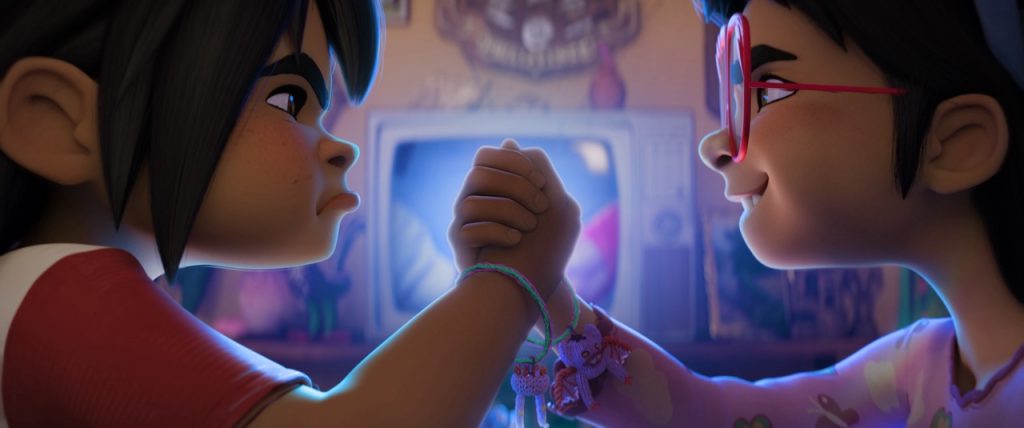
    The best parts of the film really revolve around the relationship between Jo and Raissa. The two characters could not be any more opposite. Jo is literally incendiary, with a love for firecrackers and explosives, and she has a strong tendency to act spontaneously and recklessly. Raissa, on the other hand, is more cautious and book- smart, with little doubt that she will make her dreams come true with an American education.

    Forgotten Island ForgottenIsland 1 Universal Pictures
    Forgotten Island | Photo Credit: Universal Pictures

    Yet there is something in the way they are written that makes you truly believe these two girls are best of friends. A wonderful first-act setup cements that friendship, and H.E.R. and Soberano do an excellent job bringing these two characters to life with their voice acting. 

    Forgotten Island
    Forgotten Island | Photo Credit: Universal Pictures

    We see how their friendship gets tested as Nakali becomes an unexpected place for them to finally tell each other things they have kept hidden, whether out of fear of hurting each other or looking and acting foolish. It is the core of a great coming-of-age story, and against the backdrop of a fantastical land, the potential is endless.

    Forgotten Island
    Forgotten Island | Photo Credit: Universal Pictures

    I am not personally a fan of the film’s fast-paced narrative pacing, but that comes down to a matter of taste. Crawford and Mercado do a great job of keeping things moving while directing their animation team through some truly gorgeous set pieces and artistic designs. The manananggal, voiced by Lea Salonga no less, is rendered in a way that is so different and delightfully twisted that it feels refreshing and new. As a viewer and someone who has deeply studied the lore of this specific aswang, seeing such a unique take was genuinely exciting.

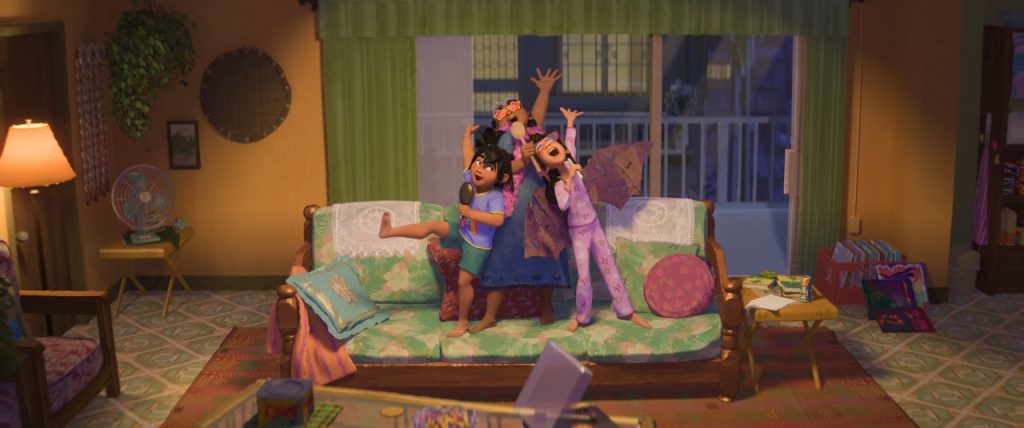
    Forgotten Island
    Forgotten Island | Photo Credit: Universal Pictures

    What holds me back is how westernized a lot of the other lore has become, for what maybe accessibility for a western audience or for not scaring little children. The kapres do not smoke, the duendes and the tiyanak are sanitized into cute mascots, and they even introdued a were-dog named Raww (voiced by Dave Franco), a creature I am not familiar with in all my studies of Philippine lower mythology. There are sigbins, sure, but they do not shape-shift into human.

    Forgotten Island 10E66 FP Forgotte 00087771 Universal Pictures
    Forgotten Island | Photo Credit: Universal Pictures

    For a film set in the Philippines in the 1990s, much of the Filipino culture feels more like an aesthetic accessory than something that really pushes the story forward. The culture elements can be interchangeable with any other setting, and core story would still stand. There is no question that the movie is exceptionally well-made, but I am wary of turning our heritage into a surface-level commodity rather than treating it as something integral to the narrative’s themes. 

    Forgotten Island 10E66 FP 1124402U 00357767 Universal Pictures
    (from left) Bungi (Manny Jacinto), Raww (Dave Franco), Raissa (Liza Soberano), Jo (H.E.R.) and Prince Mermahn (Kevin McCann) in DreamWorks Animation’s Forgotten Island, directed by Joel Crawford and Januel Mercado.

    That is why the story of the two protagonists is the one that truly grounds this film, because that’s truly cultural with us: losing a friend or even a family member due to distance. Whether it is moving from the province to Manila or migrating from the Philippines to another country for education or work, this separation is a genuine concern for many relationships here. That is the part of the culture that feels so powerfully Filipino in this story, whereas everything else could easily be substituted. 

    Forgotten Island 10E66 FP 1124402U 00097836 Universal Pictures
    (from left) Little Jo (Kailey Crawford) and Little Raissa (Kayla Teruel) in DreamWorks Animation’s Forgotten Island, directed by Joel Crawford and Januel Mercado.

    Maybe I am just being territorial or possessive. I hope the film does well, but I have my serious reservations for the Filipino-American point-of-view for a story set entirely in the country. The two leads and all the engkantos speak with a westernized English accent, while every other local characters speaks English with a thick Filipino accent. What is with that othering? It is the exact question that kept popping into my head as I watched this work unfold.

    My Rating: 4 Stars

    stars 4 0


    Ready to watch Liza Soberano and H.E.R. trigger total mythical chaos while Lea Salonga unleashes her dark side? Round up your best friends, check showtimes, and get your tickets to Forgotten Island today, just try not to lose your wings on the way in!

  • THEATER REVIEW: Inadvertently, the Enjoyable ‘Muli’ Became The Kakki Teodoro Show

    THEATER REVIEW: Inadvertently, the Enjoyable ‘Muli’ Became The Kakki Teodoro Show

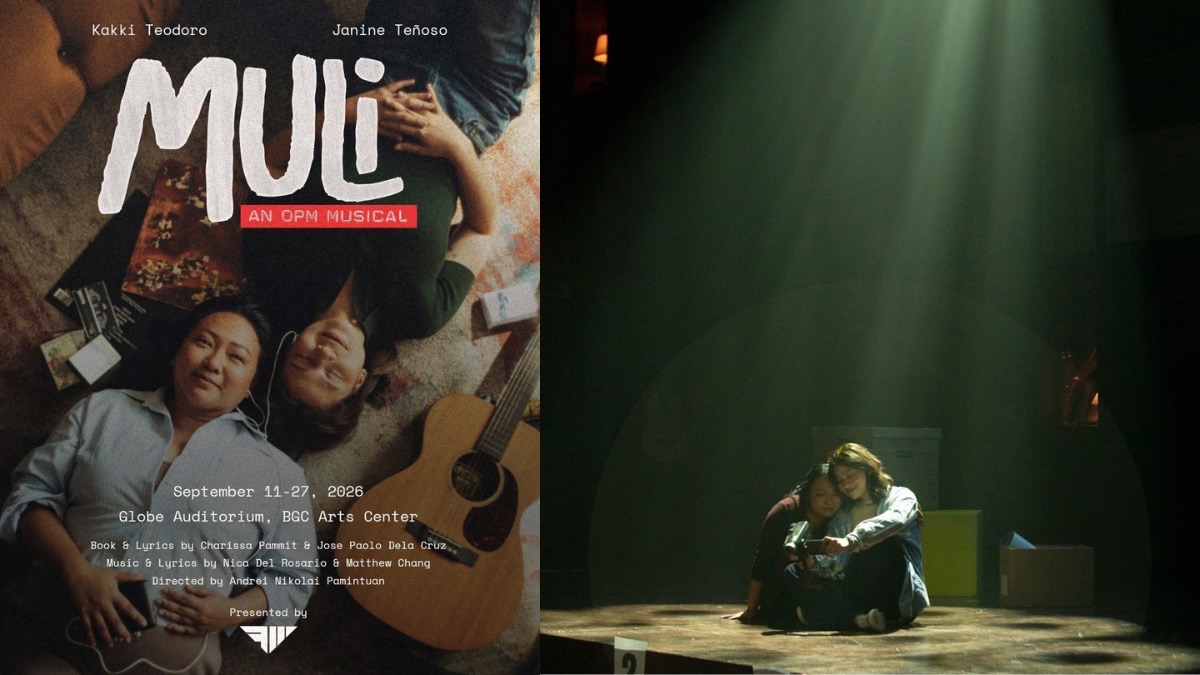
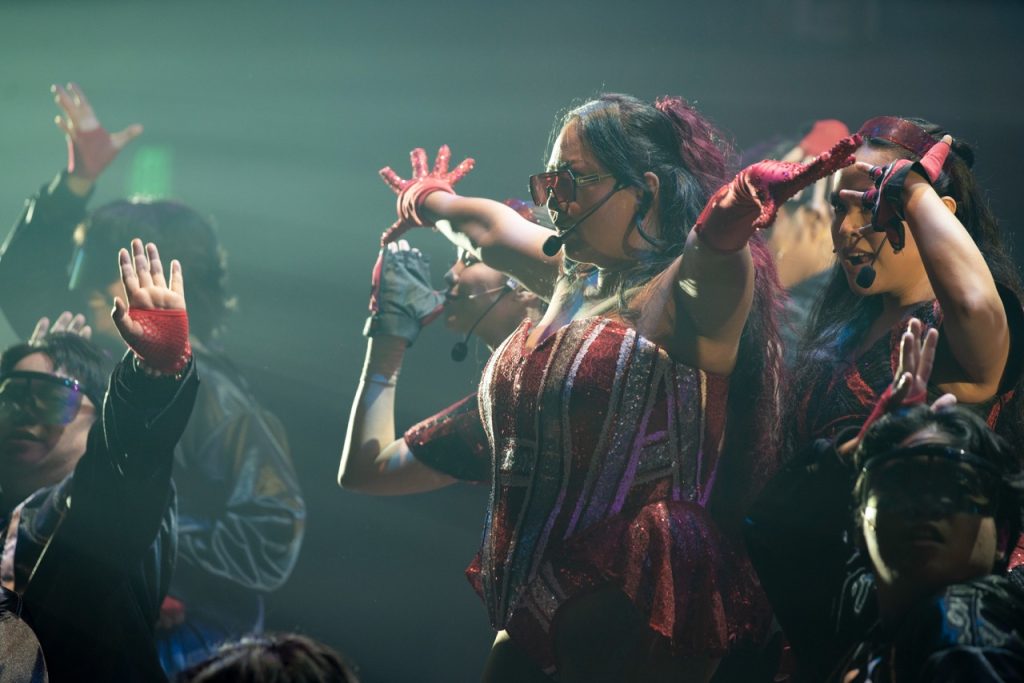
    I deeply miss original Filipino musical theater. While some jukebox musicals do good work, nothing beats new and original songs made composed specifically for the show. It’s one of the many good things about Muli, directed by Andrei Nikolai Pamintuan, written by Charissa Pammit and Jose Paolo dela Cruz, and featuring songs by Nica del Rosario and Matthew Chang. The songs are catchy and fresh. As the play travels back through time and explores dreams and “what-ifs,” the score plays skillfully with nostalgia. Certain tracks can sound very contemporary and very now while others can carry the sound of the ’90s. Hearing new original music by talented Filipino songwriters with a production that is vibrant and energetic is a pure delight.

    MULI An OPM Musical
    Image Source: MULI An OPM Musical FB Page

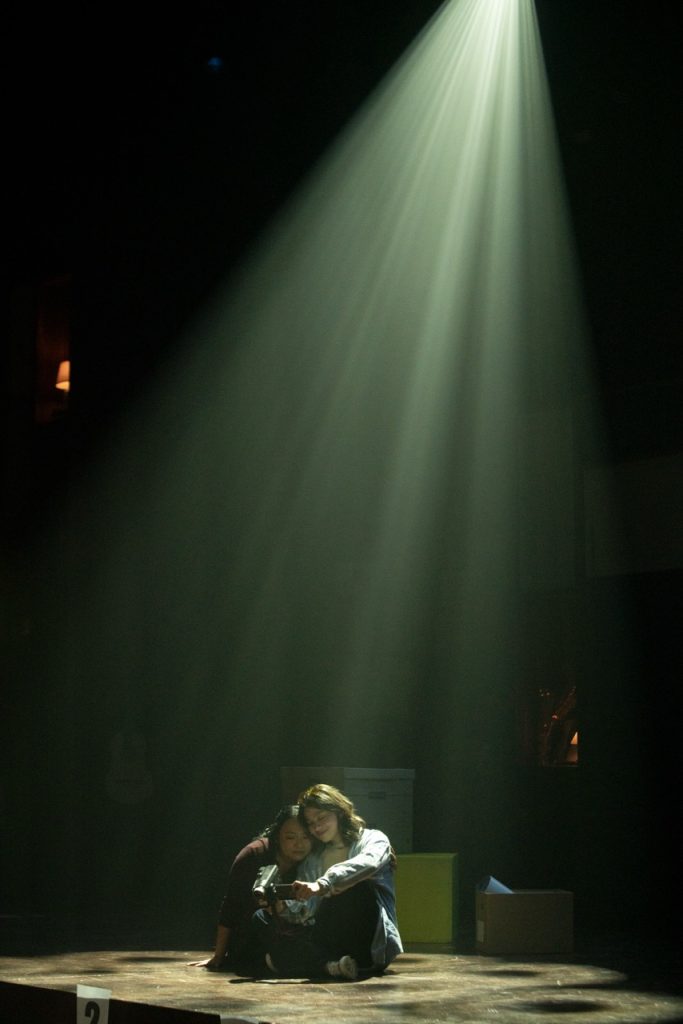
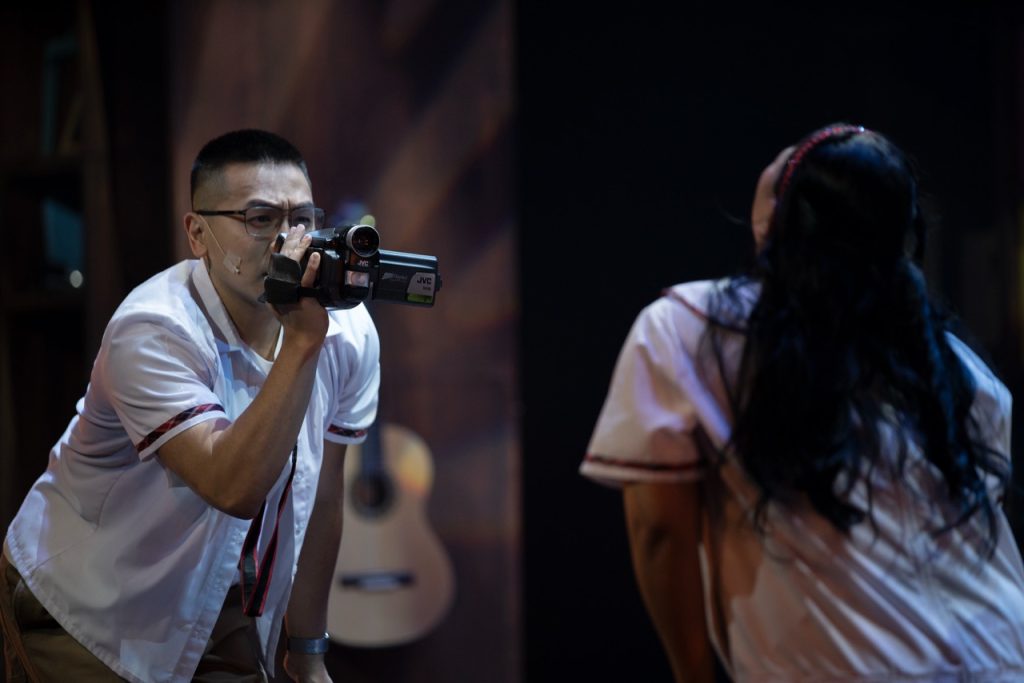
    Muli follows the story of Anita (Kakki Teodoro), a single mother whose dreams of becoming a pop star quickly ended when her daughter, Kath (Janine Teñoso), was born. As Kath urges her to declutter her home overflowing with decades of accumulated belongings (Kath calls her a “hoarder”), every single object brings back memories of a era when anything was still possible for Anita. With Kath preparing to move out, Anita has vivid dreams, alternate “what-if” realities, and just plain old trips down memory lane via a camcorder footage, all of which are acted out throughout most of the play. Yet beneath this nostalgia lies something being alluded to. Something that is amiss. Something fractured in the past has left Anita completely frozen in time and trapped in her dreams.

    Muli An OPM Musical
    Photo Courtesy of MULI, An OPM Musical

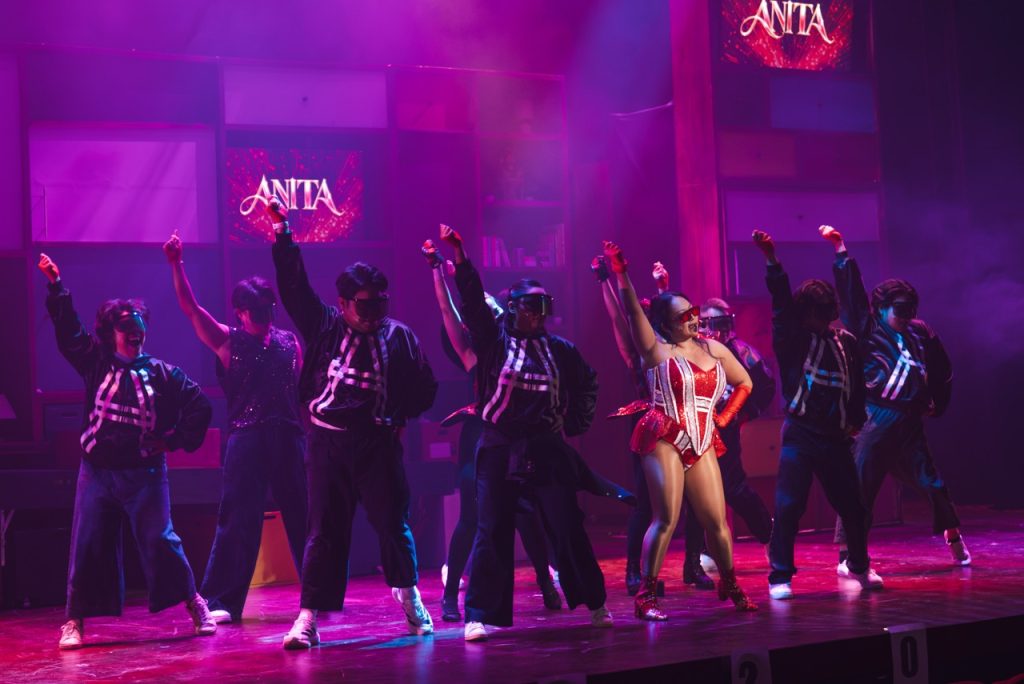
    Firstly, Andrei Pamintuan’s vision for the piece is genuinely thrilling. The stage, designed by D Cortezano (who also serves as the lighting director), features a wall of shelves filled with things that signal Anita’s hoarder tendencies. It doubles as an interactive space where actors retrieve props for every flashback, a dream sequence, or a fantasy. The shelves even swing open to reveal unexpected entrances and exits that manage to keep things surprising. At times, stagehands step in to roll out furniture pieces like desks and platforms, while other times, the actors and the ensemble handle the transitions themselves. This clever choreography creates a flow that allows the play to shift scenes seamlessly across time and memory.



    Muli Preview Night 3 An OPM Musical
    Photo Courtesy of MULI, An OPM Musical

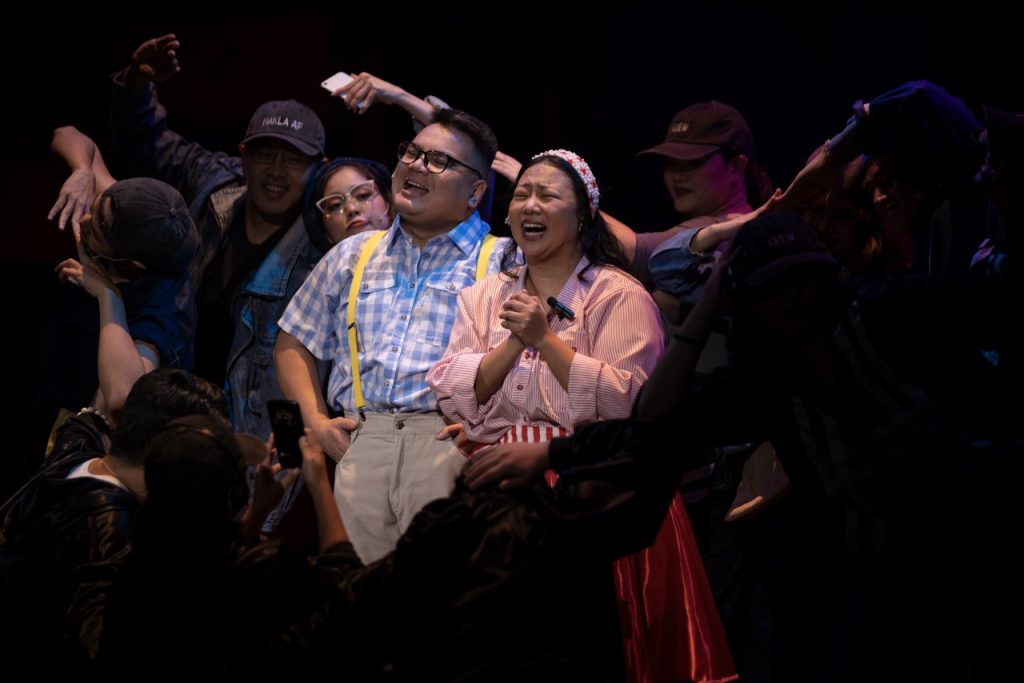
    Essentially, the play functions as an intemate two-hander between a mother and her daughter. Yet, there’s a bigger cast that is present, bringing to life figures from Anita’s past that sometimes call or exist within her dreams, fantasies, and flashbacks. This setup paves the way for big song numbers complete with energetic choreography by Julian Abuda, or bustling crowd scenes whenever Anita envisions alternate paths her life might have taken had she made different choices in high school.

    Muli Preview Night 6 An OPM Musical
    Photo Courtesy of MULI, An OPM Musical

    While everyone is fully committed to the madcap tone and feel of these alternate narratives or flashbacks – Baus Rufo, Marvin Ong, and Vien King are excellent at their roles, fitting them to a tee – there is no question that this is the Kakki Teodoro show. Not only must she embody the role of an exhausted single mother grappling with the prospect of an empty nest, but she also has to figuring out what to do with the rest of her life as her daughter leaves home. She has to play all the different facets of her. She turns into a full-pledged pop star, a sketchy CEO, a high schooler with crushes and big dreams. It is a mercurial, demanding lead role performance loaded with quick costume changes (and the costumes! Santi Obcena, take a bow!) and belting powerhouse songs across different genres and styles. Even performing while under the weather during the show I saw her in, Teodoro pulled out every single stop. She delivered every ounce of raw emotion needed for each number, and even if she was struggling with her condition, she carried through like the true veteran powerhouse she is. It’s what great performers are all about. I’m so happy to see her as a lead. It’s about time and well deserved.

    MULI An OPM Musical
    Photo Courtesy of MULI, An OPM Musical

    The production’s big secret is fairly easy to piece together if you pay close attention to the narrative clues along the way, something one can figure out if they ask the right questions as they are watching the show. I spotted it quickly, and while proven right, the reveal did not did not diminish the show’s ending. What it does, however, is raise valid questions about why certain choices of some fantasies and dreams were included in the first place. The diva pop star and the evil CEO personas feel strangely out of place for a character like Anita’s. In the real world, she has no malicious intent nor a dark side that foul for her to dream up of these characters. The CEO has the best song, though, one perfect for Teodoro, and a real highlight in terms of music and performance and direction, but it feels so off because it doesn’t come off as inherent in the character.

    Muli Preview Night 32 An OPM Musical
    Photo Courtesy of MULI, An OPM Musical

    Several of these dreams and fantasies are great when taken as is, without the rest of the narrative, but when included within the full context of the narrative, they inadvertently makes Anita appear that there’s a darker side of her that doesn’t quite fit her character at all. These moments feel disjointed, thrust into the story without real dramaturgical sense. While the political commentary related to the scene about the CEO is very much welcomed but doesn’t feel fully intrinsic to the core journey of the play. 

    Muli Preview Night 44 An OPM Musical
    Photo Courtesy of MULI, An OPM Musical

    At its core, Muli bursts with immense energy, vibrant creativity, a lot of great songs and exceptional performances. Hopefully, with a bit of fine-tuning in future runs, the play could be revisited so that all the dreams and fantasies could really integrate well with the play’s overall arching themes. Nevertheless, this was an enjoyable show and a great showcase for Kakki Teodoro.

    My Rating: 3.5 Stars

    stars 3 5

    Catch Muli, An OPM Musical live at the Globe Auditorium, Maybank Performing Arts Theater for its final weekend run this September 25 to 27! Check showtimes and get your tickets at TicketWorld before this extraordinary show takes its final bow!

  • MOVIE REVIEW: Zach Cregger’s Take on ‘Resident Evil’ Is Scary AF and Funny as Hell

    MOVIE REVIEW: Zach Cregger’s Take on ‘Resident Evil’ Is Scary AF and Funny as Hell

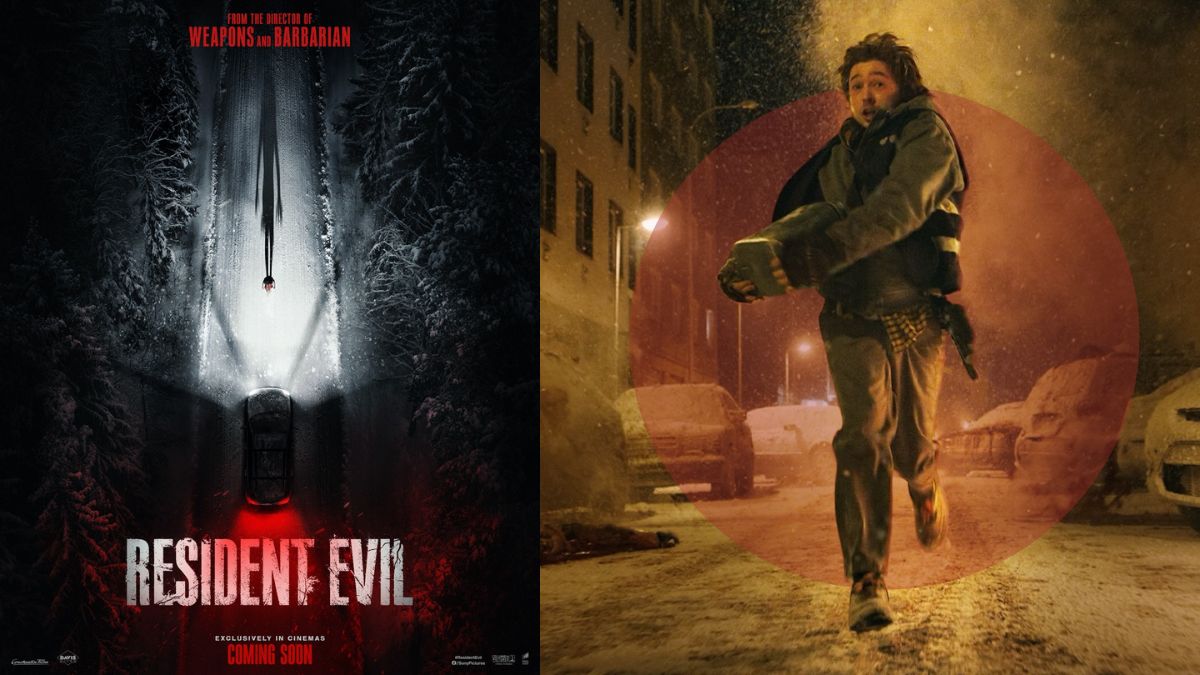
    There is really nothing quiet like sitting in a packed cinema while watching a really good horror film. That was what my exact reaction to watching Zach Cregger’s Weapons last year, and he gave me the same experience with his take on the Resident Evil franchise. His film feels like a fresh setup for the wider universe. By intentionally avoiding familiar characters from the games and previous movies – while I have watched people play the game but not for long periods, and so all I know of the franchise comes from the film adaptations – so it’s a way for viewers unfamiliar with the lore to easily get in. He focuses purely on the simplicity of the story so that he can deliver extremely scary moments and absurd situations that elicit screams and laughter in equal measure.

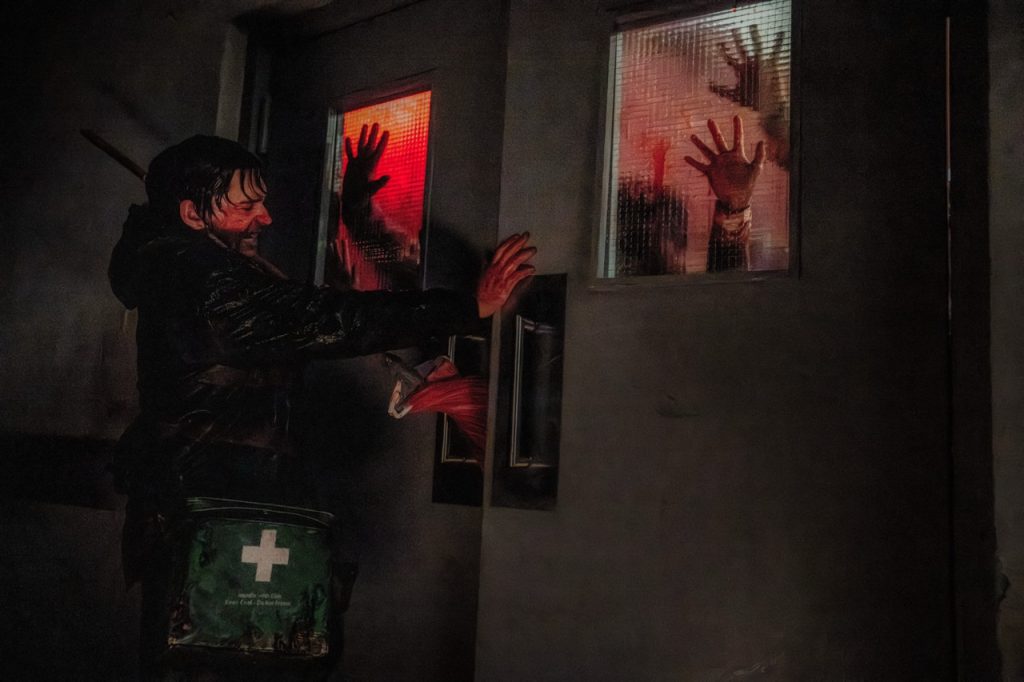
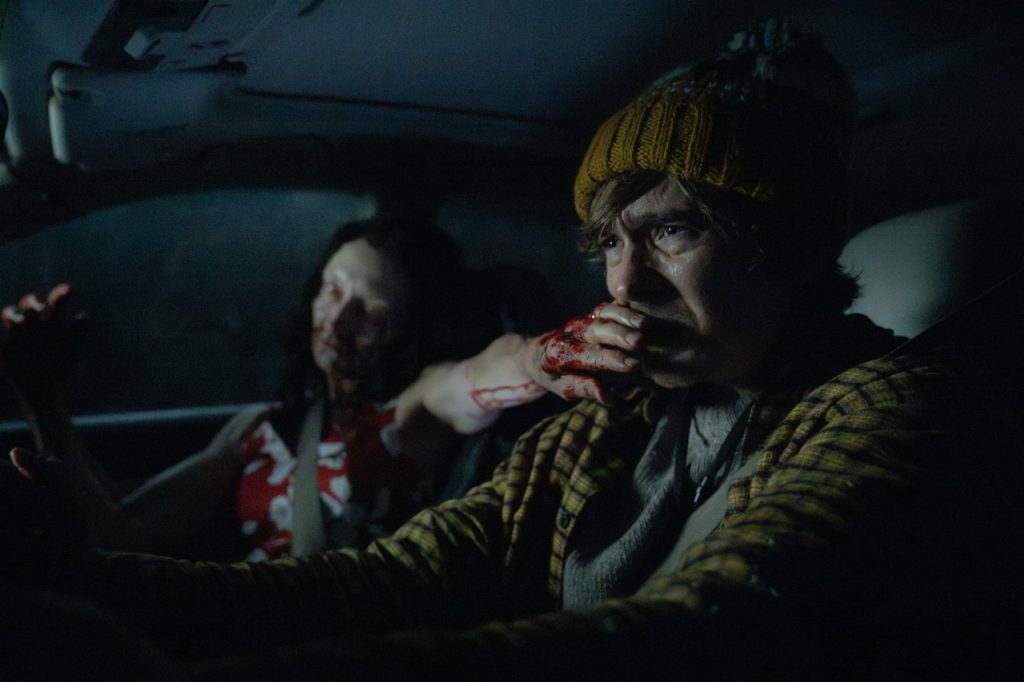
    Resident Evil follows Bryan (Austin Abrams), a medical courier who takes on an extra shift to deliver a critical medical package to Raccoon City General Hospital, miles up a mountain in the dead of winter. Motivated by news that his girlfriend might be expecting a baby, he lies about his car being equipped for traveling during heavy snow and embarks on the treacherous drive anyway. What he doesn’t know is that an outbreak has already overtaken the town, leaving the undead creatures of the franchise freely roaming the streets.

    resident evil
    Resident Evil | Photo Credit: Columbia Pictures

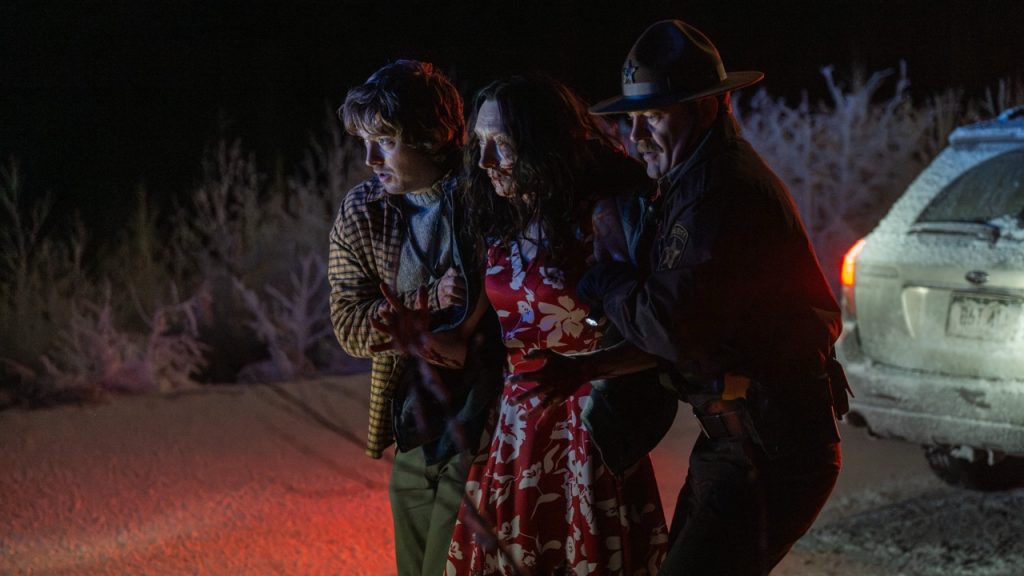
    Abrams serves as an amazing foil for us to follow. Despite his rough, gruff attitude and the failure to communicate properly with his girlfriend over the news makes him difficult to empathize with at first, the moment he accidentally hits a woman on the road, he immediately stops to help her and rush her to the hospital. We all know in our seats that this is a massive mistake. But he does not know that, and while he could easily escape, he stays. From that moment, Cregger and co-screenwriter Shay Hatten have us completely rooting for him. Abrams possesses a wonderful everyman presence that keeps him relatable, delivering a fully committed performance that grounds the character (he really looks and acts terrified when things start happening) but also manages to amplify the comedy. He is exhausted, overworked, and just wants to earn money and to do a good job. As things get progressively weirder and weirder, he stubbornly soldiers on. It is such a clever, well-written character and Abrams plays it to a tee.

    Resident Evil BRN 0925 f1016 sRGB
    Resident Evil | Photo Credit: Columbia Pictures

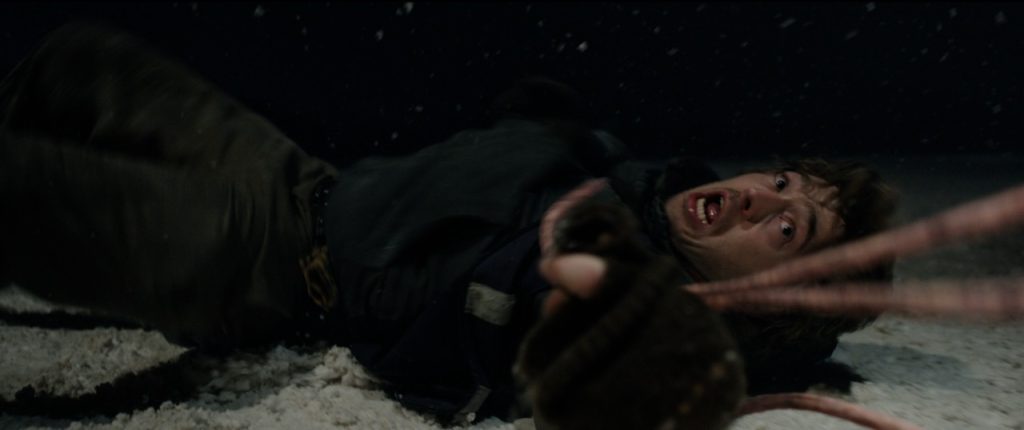
    Cregger then assumes a directorial approach heavily inspired by the video game. Tight, over-the-shoulder camera angles following the sliver of light from Bryan’s cellphone turn every dark corner into a potential jump scare. The score enters and exits with surgical precision, at just the right time that you don’t realise you are being emotionally primed for frights or laughs. When Bryan swerves his light to illuminate a strange noise, the camera lags behind by just a fraction of a second – much like a video game – and the connection to the game is there and makes the whole experience feel really immersive. We are not just emotionally tied to Bryan; we are locked directly to what he sees. We are just as vulnerable as he is.

    Resident Evil DF 04586 04548 r2
    Resident Evil | Photo Credit: Columbia Pictures

    The storytelling moves at a fast-paced, action-packed pace. The rhythm is so good that Cregger and editor Joe Murphy pace the quiet moments with the thrilling ones. They steadily build the tension as we reach Raccoon City, straight into the heart of the infestation. 

    Resident Evil DF 07602 r
    Resident Evil | Photo Credit: Columbia Pictures

    There is no real social commentary or grand metaphor that strikes me as I recall this movie, and for some reason, I don’t seem to mind at all. If anything, it is a realisation that Bryan ends up making about the possibility of him being a father, which happens at just the right moment, to heighten the stakes and the need to survive. What it does, though, the script uses this moment to deepen Bryan’s character, cementing our connection with him but makes no big statements either way.

    resident evil
    Resident Evil | Photo Credit: Columbia Pictures

    At its core, this is just a straight-up horror film that happens to be wickedly funny. It’s very well-made; the filmmaking is precise and exquisite. It is exactly the kind of movie you really want to experience in a packed theater with your friends, and hope that it’s packed so that everyone is laughing and screaming with you. It’s an experience that should be shared collectively and, honestly, I really don’t mind watching it again. Sometimes a film can exist purely just for fun with no big ambitions for any higher purpose and that’s perfectly okay. It delivers what it promises, and for that, I absolutely adore it.

    My Rating: 5 Stars

    stars 5 0


    Packed with visceral scares and side-splitting comedy, Resident Evil is an absolute blast best experienced in a packed theater with your entire barkada. Check showtimes here.

  • MOVIE REVIEW: What We Will (and Must) Remember: A Review of ‘Edjop’

    MOVIE REVIEW: What We Will (and Must) Remember: A Review of ‘Edjop’

    The key to grasping Katski Flores’ Edjop, I believe, lies in the phrase that closes the film’s opening sequence: “Inspired by memories of real events.” Edjop is not a straightforward biopic of Edgar Jopson, the legendary student activist and rebel leader of the Martial Law era. Nor is it docufiction; the film takes deliberate creative liberties to embody authentic emotional truths rather than rigid historical accuracy. As Flores noted of her collaboration in the writing of the screenplay with Jade Castro, they both worked on the recollections of Jopson’s family and friends, and the film retells events from their perspectives. 

    Edjop is a non-linear tale told in two timelines. The first anchors us in the present with his daughter, Joyette Jopson (Jodie Sta. Maria), a triathlete competing in an Arctic marathon.

    2 EdjopTheMovie
    Courtesy of EdjopTheMovie

    She is constantly asked to join memorials and events recalling the horrors of Martial Law, a period in which her father is a key figure of, but Joyette actively resists. Her athleticism, her running, is a metaphorical running away from his legacy.

    1 EdjopTheMovie
    Courtesy of EdjopTheMovie

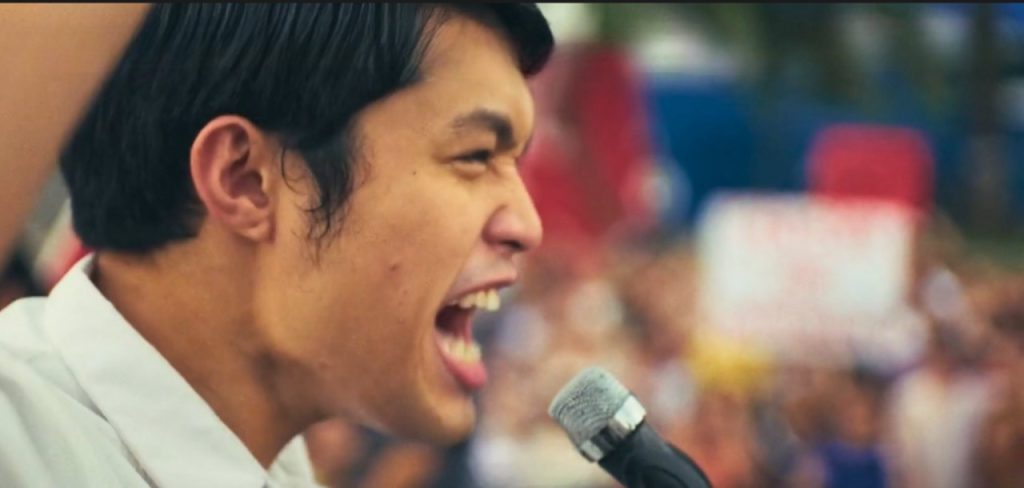
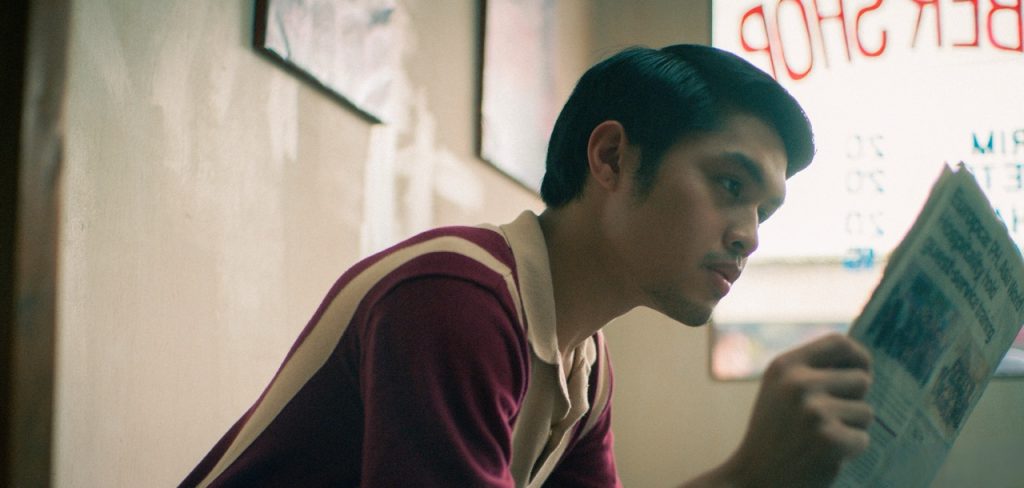
    Yet she is haunted by the stories of him and these form the second timeline of the film, as it recounts her father, Edgar Jopson (Elijah Canlas) as he becomes a student activist during the First Quarter Storm of the early 1970s into a full-blown underground communist rebel, on the run from the Marcos regime. Through this converging tracks, Joyette embarks on a journey to reconcile her father’s disappearance and come to terms with myth of a man she never truly knew.

    6 EdjopTheMovie
    Courtesy of EdjopTheMovie

    The film is not just marked by its two converging timelines, and I say converging because Flores and Castro write this film as if the past and present are entangled with each other; no easy feat. The two halves of Edjop could not be more different. The present-day scenes are shot on a mounted camera, mostly static, with Joyette framed in large, wide-open spaces. She is a woman burdened by the weight of the past.

    Edjop
    Courtesy of EdjopTheMovie

    The flashbacks, the scenes set in the past detailing her father’s activist life are shot handheld, packed with extreme close-ups. The pacing is fast-paced and thrilling. The charge of revolution vibrates through every scene, causing the two worlds to collide at every cut. Editor Benjamin Tolentino does an excellent job pacing the film, making its two-hour runtime fly by. So much is happens as we are pounded by historical events, yet it never feels aimless or drawn out.

    9 EdjopTheMovie
    Courtesy of EdjopTheMovie

    Sta. Maria and Canlas serve as excellent foils for the audience, standing as polar opposites of each other. Sta. Maria’s Joyette is dealing with an internal struggle, her conflict simmers just underneath her facial expressions, in her posture and gait, and in the quiet nuance delivery of her lines. On the other hand, Canlas is vibrant and larger-than-life.

    Edjop The Movie
    Courtesy of EdjopTheMovie

    His Edjop, the nickname of Edgar Jopson, is a character told from the collective memories of the people, friends, and family, demands a much larger canvas, and Canlas paints on it brilliantly. We also watch him evolve from an idealistic student activist into a full-blown underground rebel balancing family life, with his portrayal of the man shifts as the film leaps across timelines. It is exquisite work, really.

    11 EdjopTheMovie
    Courtesy of EdjopTheMovie

    Edjop feels big; it feels epic. Flores and cinematographer Neil Daza deliver excellent visual coverage, allowing the camera full freedom to capture the vast breadth of each scene. And we leap seamlessly from past to present, sweeping across Luzon, Mindanao, and Norway, moving from street rallies to a quiet town fiestas, and into the brutal chaos of a demolition job. This is a big movie that fully realises the ambitious scope of what it is trying to say.

    EdjopTheMovie
    Courtesy of EdjopTheMovie

    There are a few too many moments where the script takes a heavy-handed approach to Edjop’s dialogue. It gets a little too preachy at times, constantly dropping nuggets of wisdom clearly designed to encapsulate the things we need to take away from the film. Then again, this is all based on the memories of the people who remembered him. Ultimately, Edjop is meant for a specific audience: those who have forgotten, or perhaps never truly knew about the specifics of what really happened during the Martial Law era and the Marcos dictatorship.

    ELIJAH CANLAS AS EDJOP EdjopTheMovie
    Courtesy of EdjopTheMovie

    This is a big movie making big swings at any form of historical revisionism. It speaks about our history, reminding us of our heritage of fighting back whenever the system is turned against us. We all know about the EDSA Revolution, but films like Edjop exist to remind us that countless battles were fought long before the people finally surged onto EDSA. The film shows us precisely how we got there and also what sacrifices were made along the way. This is part of our history, and this movie asks us to never forget. 

    My Rating: 4 Stars

    stars 4 0


    Anchored by magnificent performances from Elijah Canlas and Jodie Sta. Maria, Edjop is an essential big-screen experience. It is a technical triumph and an urgent piece of Philippine cinema that refuses to let history fade. Check out the latest showtimes here and catch it in theaters nationwide.

  • THEATER REVIEW: A Polished Production with Great Performances, ‘The Notebook’ Struggles to Hit Its Emotional Zenith

    THEATER REVIEW: A Polished Production with Great Performances, ‘The Notebook’ Struggles to Hit Its Emotional Zenith

    I have never read The Notebook by Nicholas Sparks, but I have seen Nick Cassavetes’ film adaptation starring Rachel McAdams and Ryan Gosling. Surprisingly, I have watched a lot of movie adaptations of books written by Sparks; while I cannot say I enjoy them all, there is a distinct formula to them that I find comforting and somehow appeals to my closet-romantic nature. So I was excited to catch Theater Group Asia’s production of The Notebook The Musical, even without knowing much about the stage version itself. The songs were written by Ingrid Michaelson, a singer-songwriter whose music career I have been a fan of during her early record.

    The musical’s book, written by Bekah Brunstetter, follows a non-linear storyline depicting the main characters, Allie and Noah, across three distinct timelines. The story opens in a nursing home, where an elderly Allie lives with dementia while Noah refuses to leave her side.

    The Notebook The Musical
    Celeste Legaspi as Older Allie, Rody Vera as Older Noah | Photo: Jyllan Bitalac & Sherie Bolo | Courtesy of Theatre Group Asia’s The Notebook The Musical (Artistic Director: Clint Ramos; Executive Director: Christopher Mohnani)

    As he reads to her from her handwritten notebook, a diary she kept, the and this thrusts us into the past, where two different versions of Noah and Allie act out their youth. Young Noah and Young Allie portray their first meeting and their falling in love. While middle Noah and Middle Allie, after years of not having seen each other; Noah has returned from the war to fulfill a promise, while Allie finds herself engaged to be married to another man just as their paths cross once again. 

    The Notebook The Musical
    Photo: Jyllan Bitalac & Sherie Bolo | Courtesy of Theatre Group Asia’s The Notebook The Musical (Artistic Director: Clint Ramos; Executive Director: Christopher Mohnani)

    At its core, The Notebook is a classic love story about two lovers who meet each other and fall in love but their circumstances try to keep them apart, who nevertheless defy all odds and refuse to let each other go. 

    The Notebook The Musical
    Photo: Jyllan Bitalac & Sherie Bolo | Courtesy of Theatre Group Asia’s The Notebook The Musical (Artistic Director: Clint Ramos; Executive Director: Christopher Mohnani)

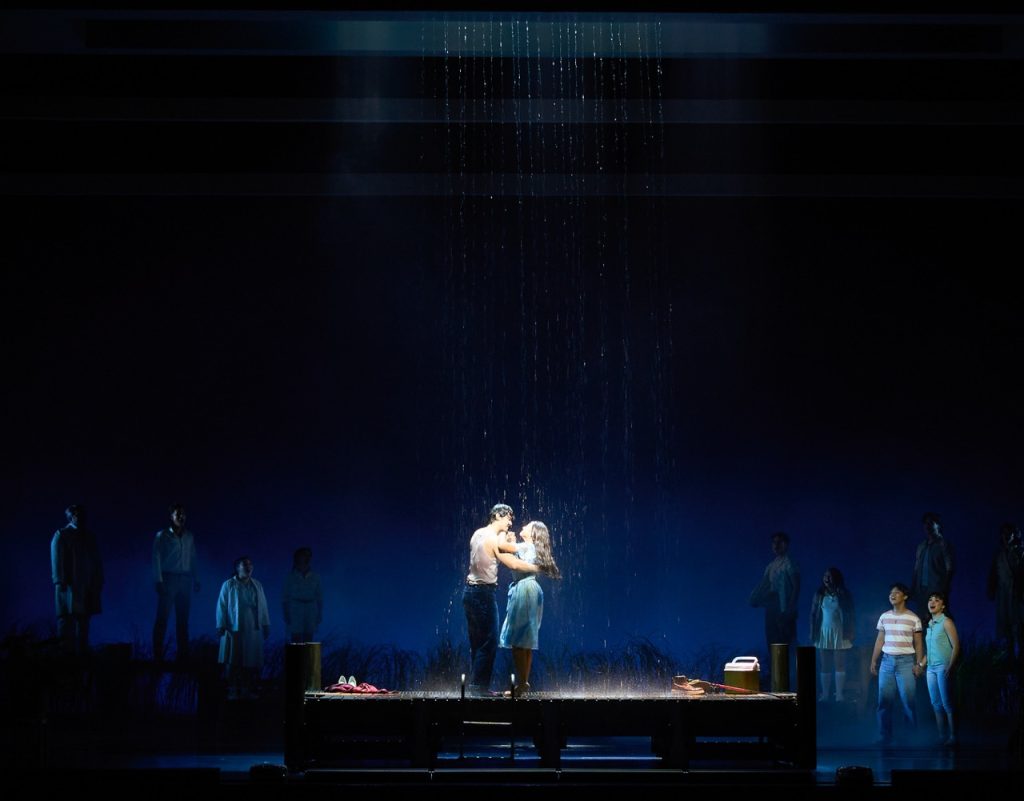
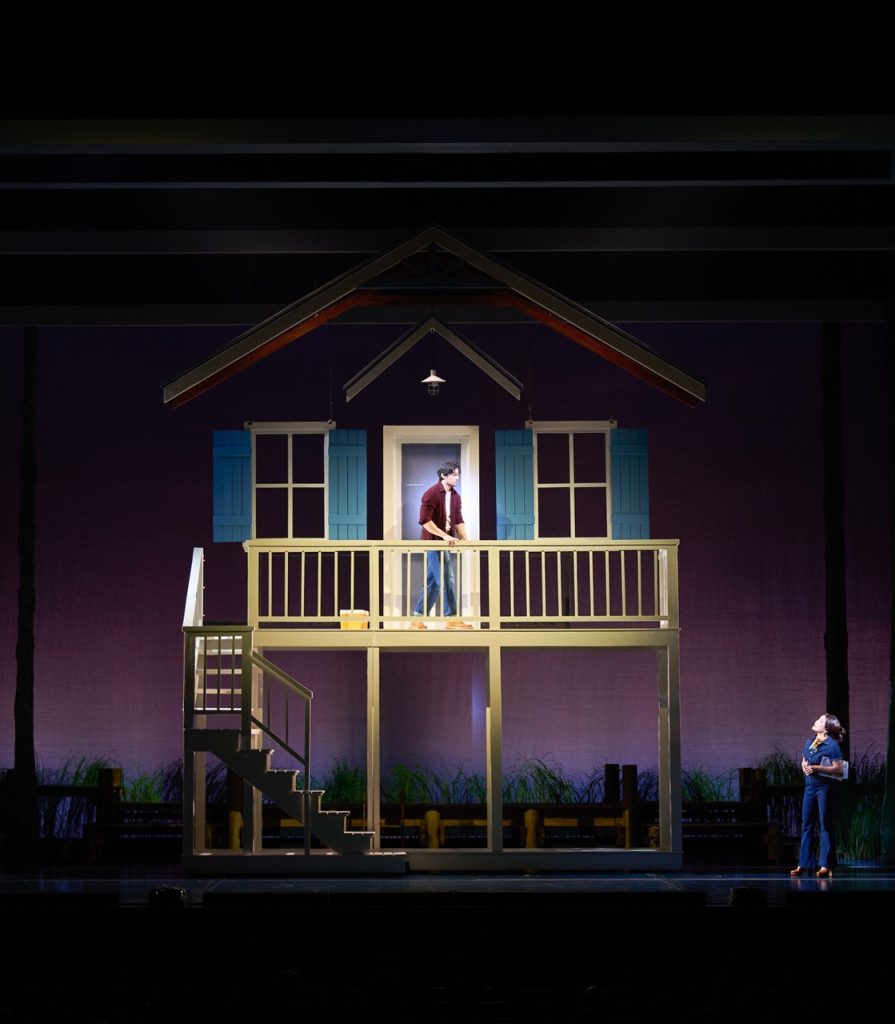
    Directed by Nicholas Polonio, The Notebook The Musical emerges as a very polished staging that showcases some really good vocal performances from its cast, most notably from Morissette, who bring incredible depth and vocal power to Middle Allie and a set design that’s dynamic and inventive. There’s a massive dropdown screen frames that allows Older Noah and Older Allie to have their scenes upstage in the nursing home and as they journey into memory of the past, the screen lifts up to give us some gorgeous set designs by Miguel Urbino.

    The Notebook The Musical

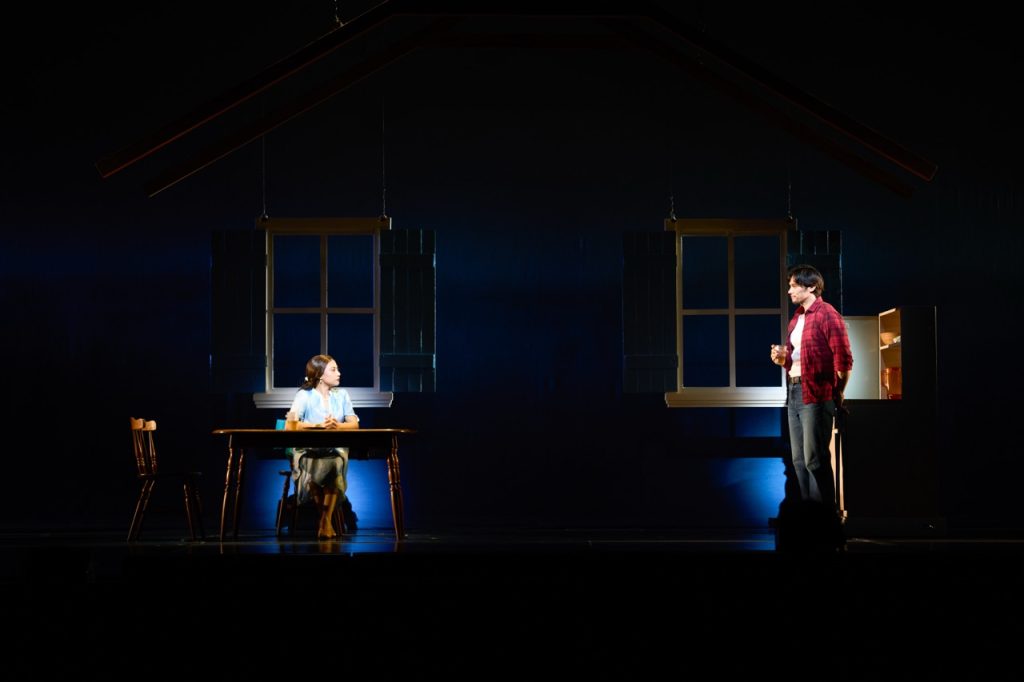
    The stage transitions between a dock, complete with a rowboat, a frame representing the “haunted house” (that carries a promise with immense story implications), a bedroom with a huge bed, and a two-story house with stairs and a balcony. These sets are incredible to look at and Polonio’s use of the dropdown projection screen and some additional sliding screens at the side allows him total cinematic command over the show’s overall imagery of each scene. It’s almost cinematic.

    The Notebook The Musical
    Laurence Mossman as Middle Noah, Jillian Ita-as as Georgie | Photo: Jyllan Bitalac & Sherie Bolo | Courtesy of Theatre Group Asia’s The Notebook The Musical (Artistic Director: Clint Ramos; Executive Director: Christopher Mohnani)

    Positioned behind the stage, the orchestra delivers a rich, lush soundscape that far surpasses the arrangements of earlier productions. Musical director Farley Asuncion brings out all the emotions from his arrangement. Later, the orchestra is revealed along with another set change at the height of one of the musical’s most emotional moments for full effect. It’s quite strong.

    Theatre Group Asia s The Notebook The Musical Morissette as Middle Allie Laurence Mossman as Middle Noah 1 TGA
    Morissette as Middle Allie, Laurence Mossman as Middle Noah | Photo: Jyllan Bitalac & Sherie Bolo | Courtesy of Theatre Group Asia’s The Notebook The Musical (Artistic Director: Clint Ramos; Executive Director: Christopher Mohnani)

    Without highlighting the root cause of their break-up, overshadowed by all the montages of Noah and Allie falling in love, the musical renders its central conflict feels manufactured rather than rooted in a relatable, universal truth. Hidden by all the romantic parts, the conflict (or lack of it) doesn’t really give the musical the tension to reach its emotional zenith. Yes, Older Allie has dementia but that’s also a conflict that cannot be won over by choice. 

    Theatre Group Asia s The Notebook The Musical Sheena Belarmino as Younger Allie Benedix Ramos as Younger Noah TGA
    Sheena Belarmino as Younger Allie, Benedix Ramos as Younger Noah | Photo: Jyllan Bitalac & Sherie Bolo | Courtesy of Theatre Group Asia’s The Notebook The Musical (Artistic Director: Clint Ramos; Executive Director: Christopher Mohnani)

    Yet despite its technical flourishes and a powerhouse performance from Morissette, I found the play to lack a certain tension that would amplify the narrative’s conflict. I feel the problem is in the book. Benedix Ramos, Laurence Mossman, and Rody Vera, playing Young Noah, Middle Noah, and Older Noah, respectively, do a great job at portraying the charming romantic lead. Their collective Noah is a bundle of goodness and devoted to his love for Allie. Because of the way he’s written and then performed, there seems to be no real reason why Allie’s parents would be against him other than class discrimination. There are no rough edges in this Noah; no brusque temper, and no underlying danger. Noah is simply a good man. It doesn’t help that Ingrid Michaelson’s songs give him a lot of high notes (which each actor sings well) to sing and he’s always longing for her that there seems to be no real reason for them to be apart except for this discrimination that doesn’t get enough moments to be fully realised.

    Theatre Group Asia s The Notebook The Musical Morissette as Middle Allie Sheena Belarmino as Younger Allie Celeste Legaspi as Older Allie TGA
    Morissette as Middle Allie, Sheena Belarmino as Younger Allie, Celeste Legaspi as Older Allie | Photo: Jyllan Bitalac & Sherie Bolo | Courtesy of Theatre Group Asia’s The Notebook The Musical (Artistic Director: Clint Ramos; Executive Director: Christopher Mohnani)

    The cast members, led by Sheena Belarmino, Morissette, and Celeste Legazpi, who embody the three versions of Allie, young, middle, and old, respectively – are also giving it their all but it’s a show that doesn’t fully maximize the elements of its story, especially its conflict.

    It still hit home for the ladies beside me when I watched; each one holding back tears and swooning at every romantic milestone. The Notebook The Musical is an impeccably polished production with a lot of great technical work involved and standout vocal performances. There is no question about that. Yet the material itself has its issues that hinder a good show from becoming a truly great one.

    My Rating: 3 Stars

    stars 3 0

    A story loved around the world, proudly built in the Philippines by Filipino artists, for Filipino audiences: Theatre Group Asia’s production of The Notebook The Musical must close on September 20 at the Samsung Performing Arts Theater. Experience the music and stellar performances for yourself before the run ends. Grab your tickets now via TicketWorld.