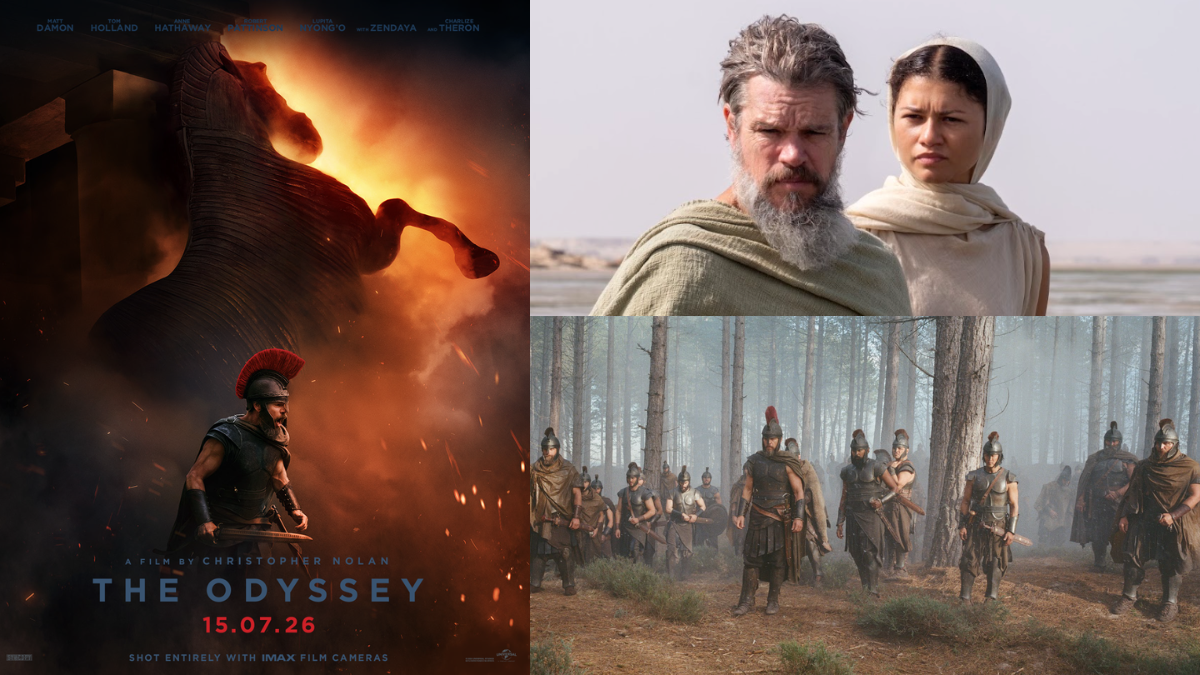
There’s no question that Christopher Nolan is a filmmaker who makes movies for the cinema. His stories are always larger-than-life, even his earlier work before his name became a box office draw – films like ‘Memento’ and ‘Insomnia’ – were best suited on the big screen where the visual breadth of his stories amplified his message when projected at that scale. Success only allowed Nolan to work on even larger-scale movies, and with the dramatic success of ‘Oppenheimer,’ he has now been given full reign to make one of his dreams come true: to film an entire movie completely on IMAX film cameras. He takes Homer’s The Odyssey and uses translations by Emily Wilson, E. V. Rieu, and Robert Fagles as the basis of his screenplay.
With a star-studded cast that includes Matt Damon, Anne Hathaway, Tom Holland, and Robert Pattinson in lead roles with a stellar supporting cast that includes Charlize Theron, Zendaya, Samantha Morton, Jon Bernthal, John Leguizamo, Himesh Patel, and Lupita Nyong’o, ‘The Odyssey’ primarily uses practical effects with as little CGI as possible to create a very tactile, tangible fantastical world where myths, mythology, and legends co-exist and fill up each frame with the themes that Nolan is set to deliver to his audience.
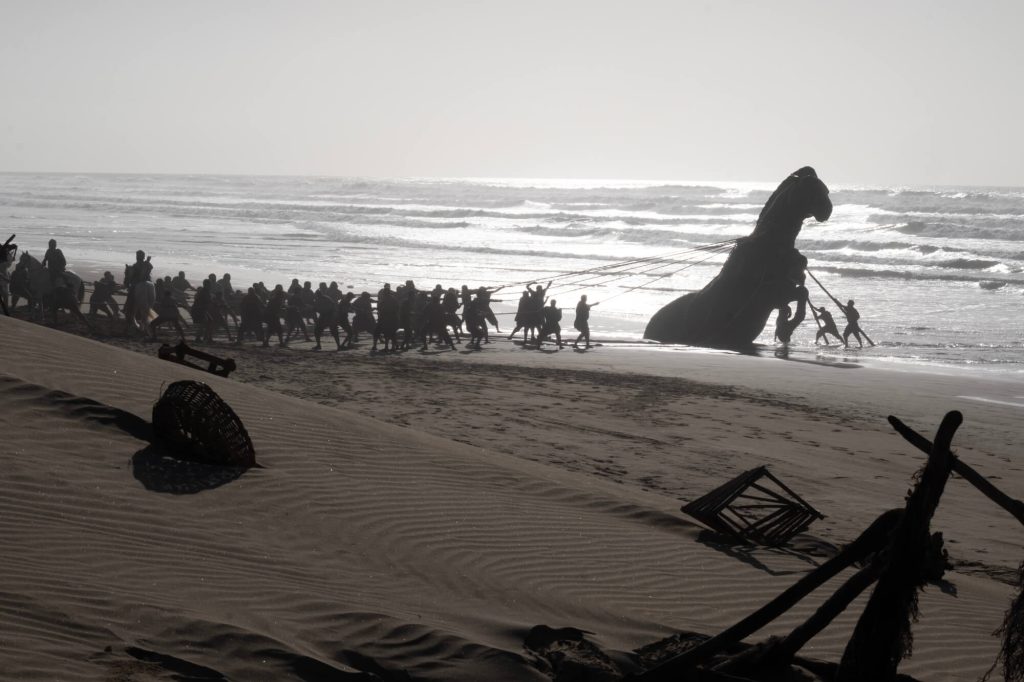
Told from two points of view, ‘The Odyssey’ takes place after the Trojan War. In Ithaca, Penelope (Hathaway) awaits the return of her husband and king, Odysseus (Damon) but his 8-year absence since the fall of Troy has everyone assuming that she is now a widow. Suitors have come to marry her to take Ithaca as their own, among them is Antinous (Pattinson). The suitors grow in number, and Zeus’s law bids that all strangers must be welcomed. Telemachus (Holland), son of Odysseus and Penelope, laments that the suitors have feasted away Ithaca’s resources. Still too young to become king, Ithaca’s future is tenuous and Penelope is losing hope. While far away from Ithaca, Odysseus is on an island with the nymph Calypso (Theron), who is fed lotus flowers, which takes away his memory. Calypso wants Odysseus for herself but there’s a longing in him that the flowers can’t take away. To find his way home, he must recall who he is and how he got to that island, and from this retelling, we discover the adventures Odysseus has taken to return home, which includes battling a cyclops, facing the goddess and witch Circe (Morton), and flashbacks of what happened in the battle of Troy.
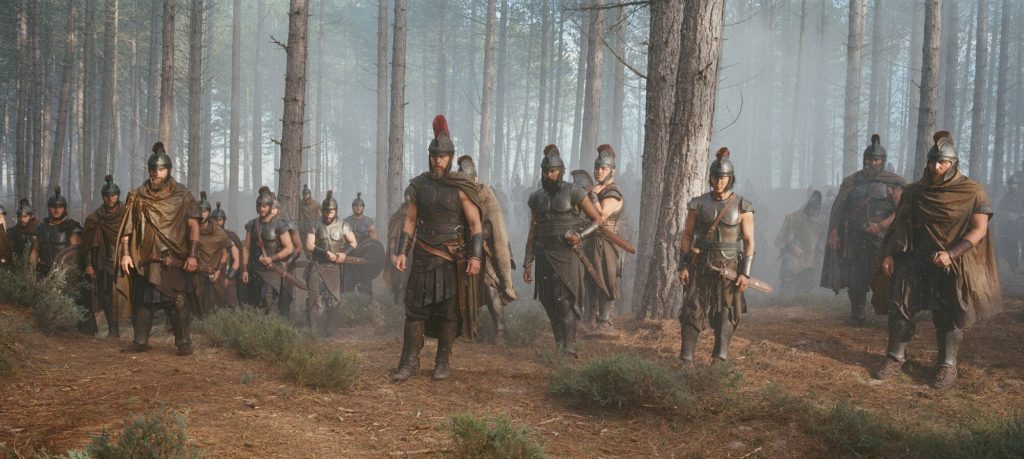
Interestingly enough, Nolan employs the use of storytelling to frame his narrative. In Ithaca, we learn about Penelope and Telemachus and of Odysseus through recollections of their time together, and of stories told during the feasts. For the Odysseus portion, it is through remembering his journey that we see his adventures. Almost like a recited epic poem back in the era of Homer and the Greeks, the story is told in story-form, enforcing the myth and myth-making nature of film and this particular approach to the telling of this story.
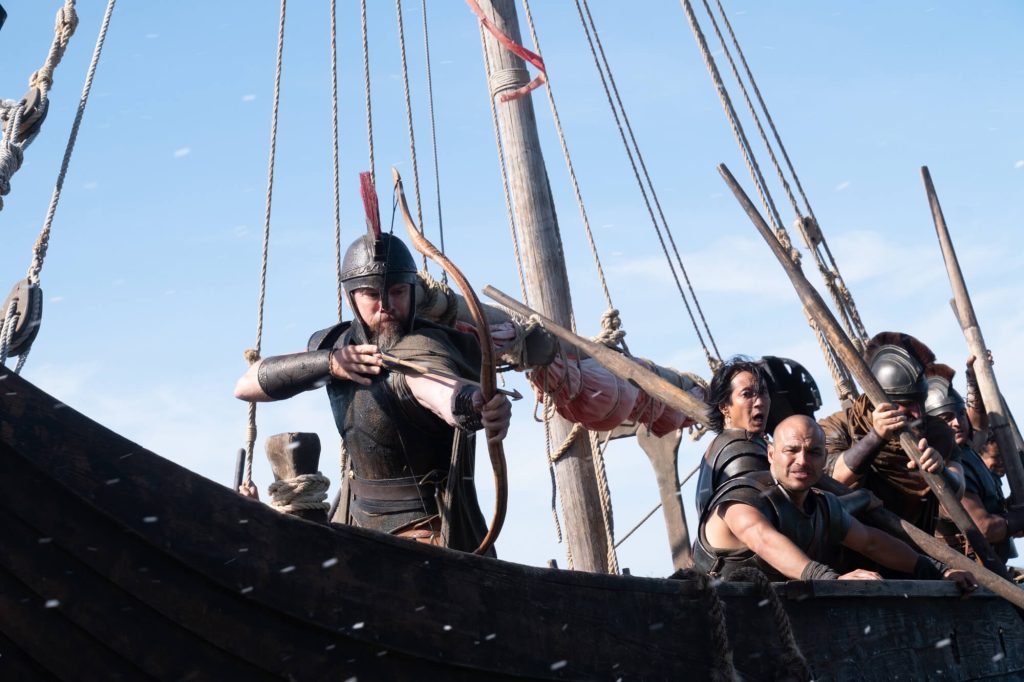
Nolan, alongside director of photography Hoyte van Hoytema, fully utilizes the IMAX format to create a film of epic proportions. The long shots puts these characters and situates them in these vast expanse of space, visualizing Odysseus’ journey as a challenge of not just physical distance but an emotional one as well (for the film puts into question an existential force that keeps him from getting home quickly) whereas Penelope and Telemachus are constrained and imprisoned by the burden of the castle, of the kingdom, and of its laws. Even in the close-ups, the emotions at the scale are heightened and Nolan is unafraid to point his camera away from the heroics and put into center frame the characters who are suffering from the effects of this war. Slaves, soldiers, and women, amongst others are brought into the composition so that we understand that Nolan’s ‘The Odyssey’ is not just an adaptation of the Greek myth that we were taught in elementary but a searing rebuke of war and the human cost of it and of Odysseus’ part in the fall of civilization.
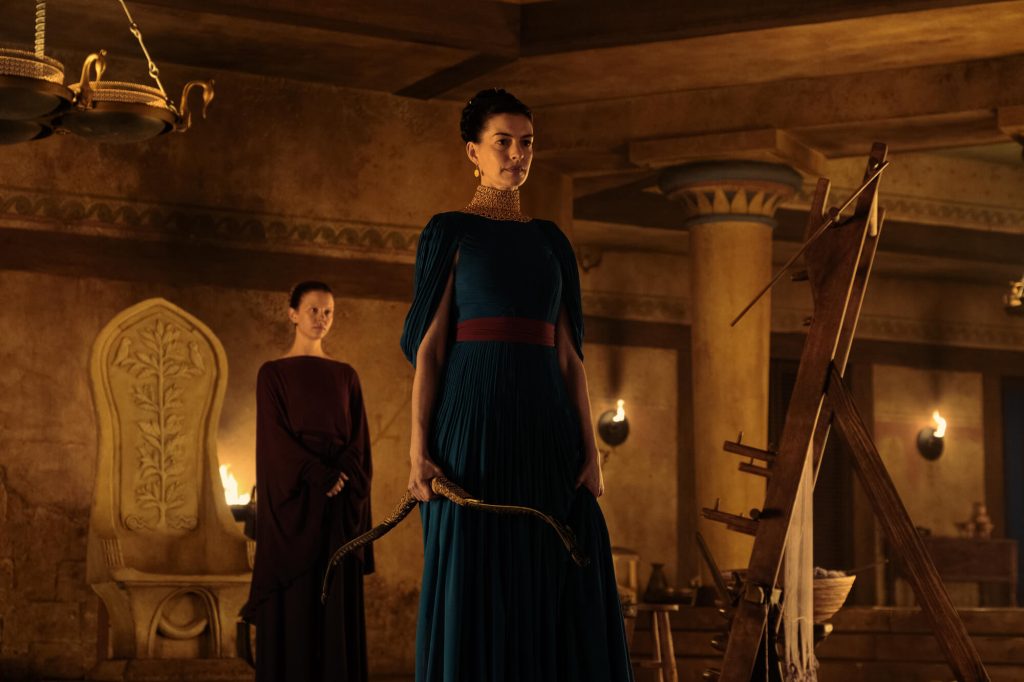
What begins as a fantastical journey and a suspenseful political battle at the homefront seamlessly turns into a dissection and cross-examination of where and when and how humanity began to break down and it all returns to the fall of Troy. Taking his cues from the Wilson translation, the usage of contemporary language and straying from the usual portrayals of formal British accents for these ancient Greek mythological characters, the way the film manages to find its connections with current-day issues and discussions about war, destruction, corruption, misogyny, and the loss of human kindness and decency.
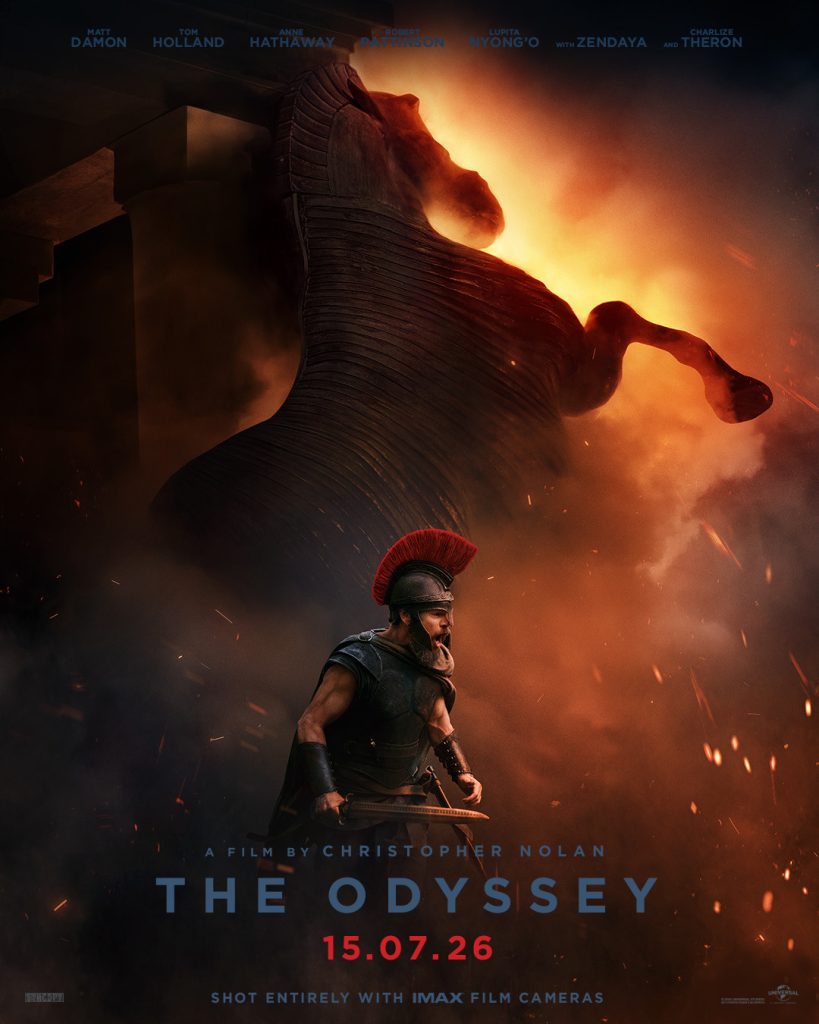
I cannot stress how seamlessly and quietly Nolan infuses modern day political discourse in a film that is so visually arresting and so entertaining that when the film’s finale takes place and you realise what this movie is really about; you cannot escape it and it is something you will bring with you as you leave that theater.
This is an incredible piece of work and it is a highlight of an already remarkable filmography by Christopher Nolan, his cast, and his team. A must-watch on IMAX.
My Rating: 5 Stars

Ready for an unforgettable cinematic journey? Experience Christopher Nolan’s The Odyssey on the biggest screen possible. Get showtimes here.
Leave a Reply
You must be logged in to post a comment.