
Tag: Ang Kaliitan Ng Kasalukuyan

  • THEATER REVIEW: Dulaang UP’s “Ang Kaliitan ng Kasalukuyan” As an OFW Story That Never Arrives Home

    THEATER REVIEW: Dulaang UP’s “Ang Kaliitan ng Kasalukuyan” As an OFW Story That Never Arrives Home

    From the moment you take your seats at the IBG-KAL Theater in UP Diliman, you will be intrigued by the stage design for Ang Kaliitan ng Kasalukuyan. Aaron Misayah’s scene design features an impressively large white ramp that serves as a traverse stage, with the audience seated on opposite sides. One colleague described it as a skateboard ramp and my first impression was that of a water slide. Later, I’d realise that my first impression rang true but more on that later. At the very end of the stage are seats that were meant to resemble a waiting area in an airport. Some cast members are already seated, in costume, waiting, as the audience trickles in. Hanging above is a tiled platform that opens up to bring down certain set design elements like a door. The amount of stage elements were actually quite commendable except that as the play unfolds, there’s just too much that it starts to feel comical. 
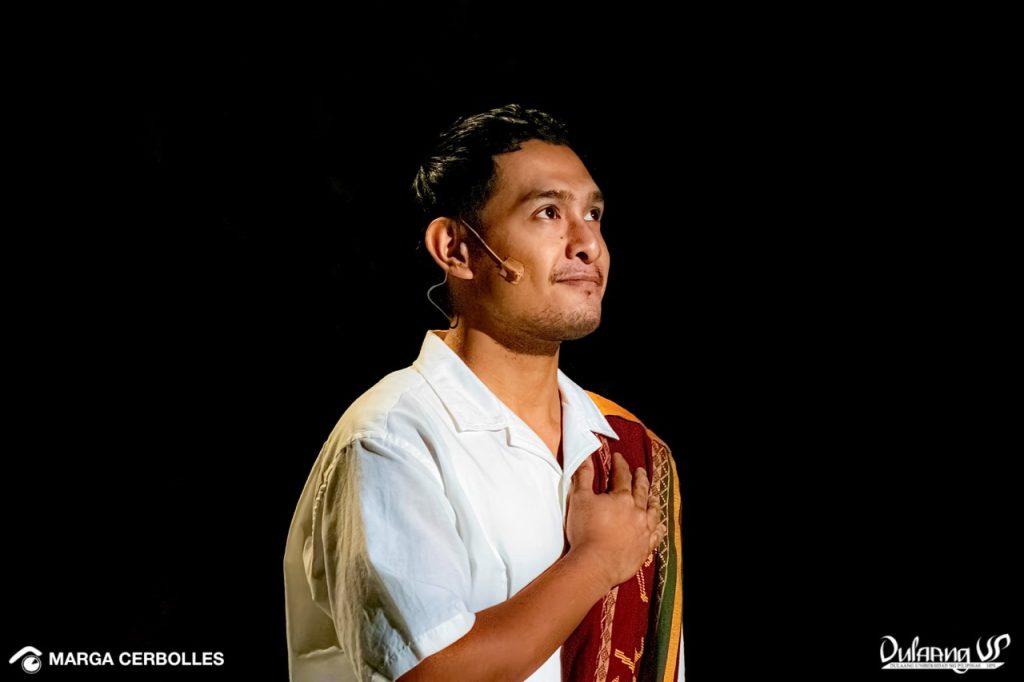
    Dulaang UP Ang Kaliitan ng Kasalukuyan 4843fee
    Dulaang UP Ang Kaliitan ng Kasalukuyan | Photo by Marga Cerbolles

    Written and directed by Dulaang UP’s new artistic director, Palanca winner Arlo De Guzman, Ang Kaliitan ng Kasalukuyan explores the story about OFW experience. Lead by Sandino Martin (playing Bulan), an OFW working in Dubai and the son of two former OFWs. In the first act, Bulan returns home and is surrounded (maybe even suffocated) by the love of his family who hail him as a hero. They rely on him for his remittances to help the family build a home and a business. As Bulan interacts with family members and old friends in his hometown, he longs to be able to return for good. But in the second act, he returns to Dubai and struggles with the burden of responsibility. He does not want this life that was handed down to him by his parents, he wants to break free from the Filipino custom that the child must repay the sacrifice of the parents. 
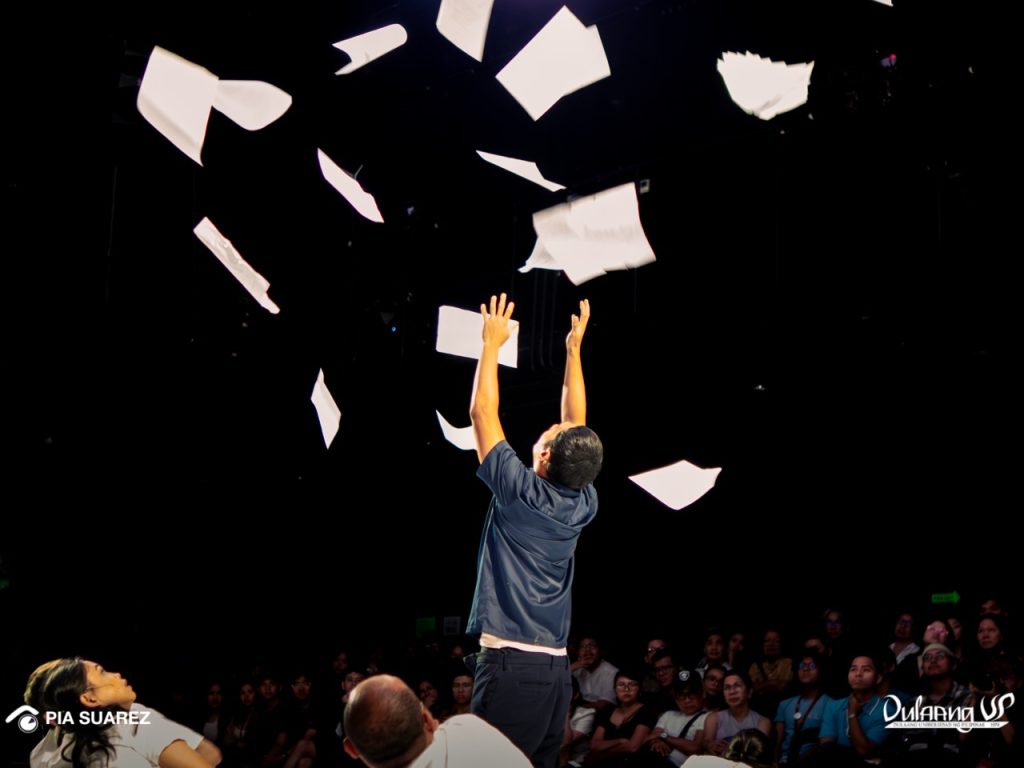
    Dulaang UP Ang Kaliitan ng Kasalukuyan 8
    Dulaang UP Ang Kaliitan ng Kasalukuyan | Photo by Pia Suarez

    There’s a whole lot of theater going on in Ang Kaliitan ng Kasalakuyan that both the play and performances are weighed down by all the stagecraft involved. The first act has a chorus, cast members all in white, narrating the story, providing the exposition before exiting and returning as other characters. This chorus does not return until the finale when they come back to moralize against Bulan’s own interrogation about his family obligations. There’s puppetry, a story told to Bulan as a child by his grandmother and the younger Bulan is portrayed as a puppet.
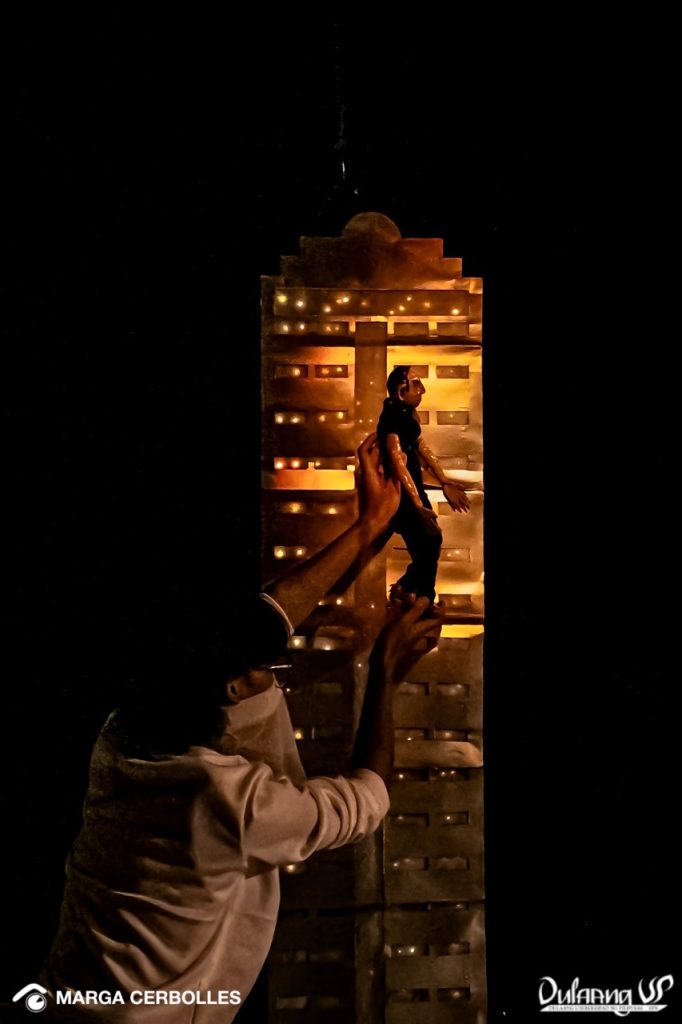
    Dulaang UP Ang Kaliitan ng Kasalukuyan be3
    Dulaang UP Ang Kaliitan ng Kasalukuyan | Photo by Marga Cerbolles

    Later, in act two, another puppet appears, a sort of like “Jiminy Cricket” character in Disney’s “Pinocchio,” who is about a foot and a half high and sits on Bulan’s shoulder and gives him someone to vent and rant to. As Bulan is picked up from the airport by his father, the cast members go on a ride on chairs meant to look like a car but a remote-control car precedes them. It’s a theatrical element that is used for only two minutes and does nothing really but distract us from the conversation Bulan has with his family. Later, a huge puppet made, the size of a truck maybe, with arms that grasps Bulan as a symbol of the Middle East’s hold over him. And the water slide design of the stage? At some point, water begins to flow, turning the stage into a little creek.
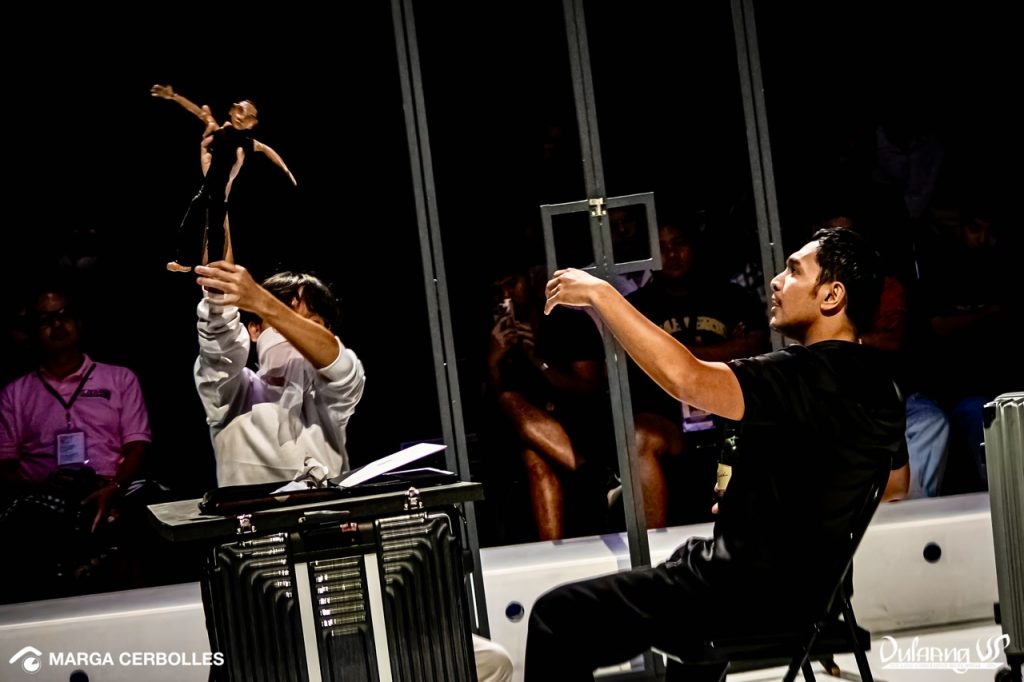
    Dulaang UP Ang Kaliitan ng Kasalukuyan 77a68d4

    Also, it’s sort of a musical with three or four songs sung in the first act and then no more in the second act until the finale.
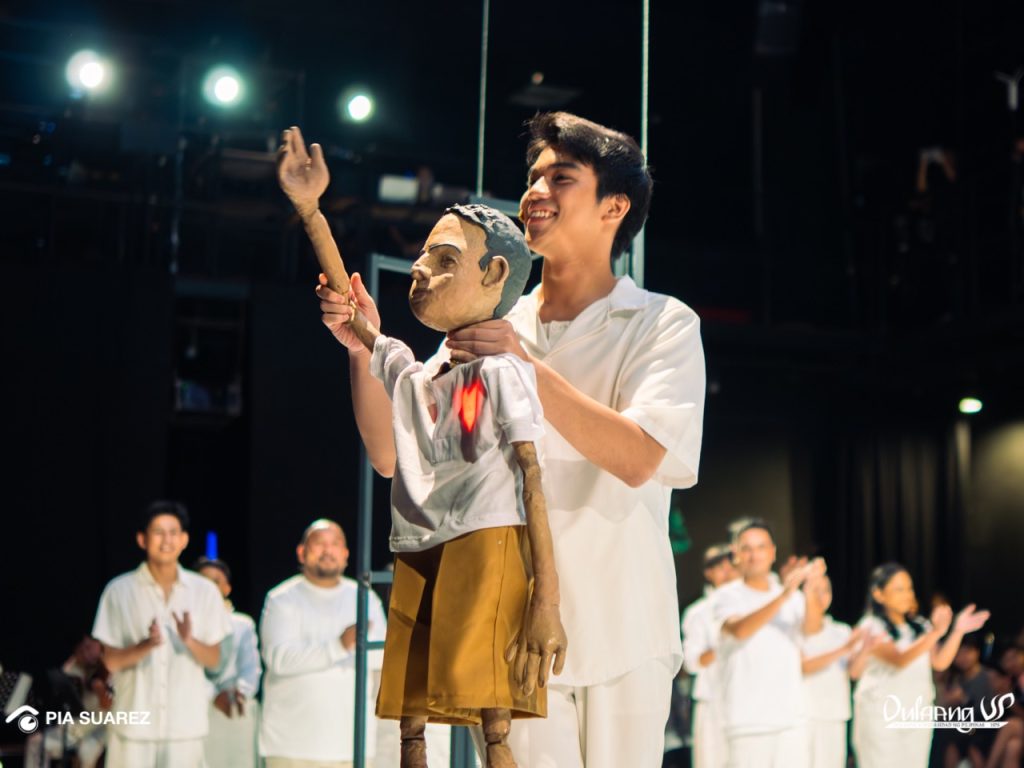
    Dulaang UP Ang Kaliitan ng Kasalukuyan 11

    Aside from the remote-control car, all the theatrical devices are actually quite impressive if they were not mashed up together in one play that never really feels cohesive. A lot of the inner world of the characters are said out loud, giving nothing for the audience to stew on. The play, as written, feels so literal that the theatrical devices feel utilized to make the play seem more like a play than a weekend television movie. It’s because of how on-the-nose the writing is that I can’t really comment on the performances because there was no real subtext for the actors to really play out. The way the play was written, what you see and hear is exactly what you get. And these are OFW stories that are familiar to us; we have a lot of this already in film and television and in theater. The big theatrical devices made the play seem bigger but not necessarily weightier or meatier. 
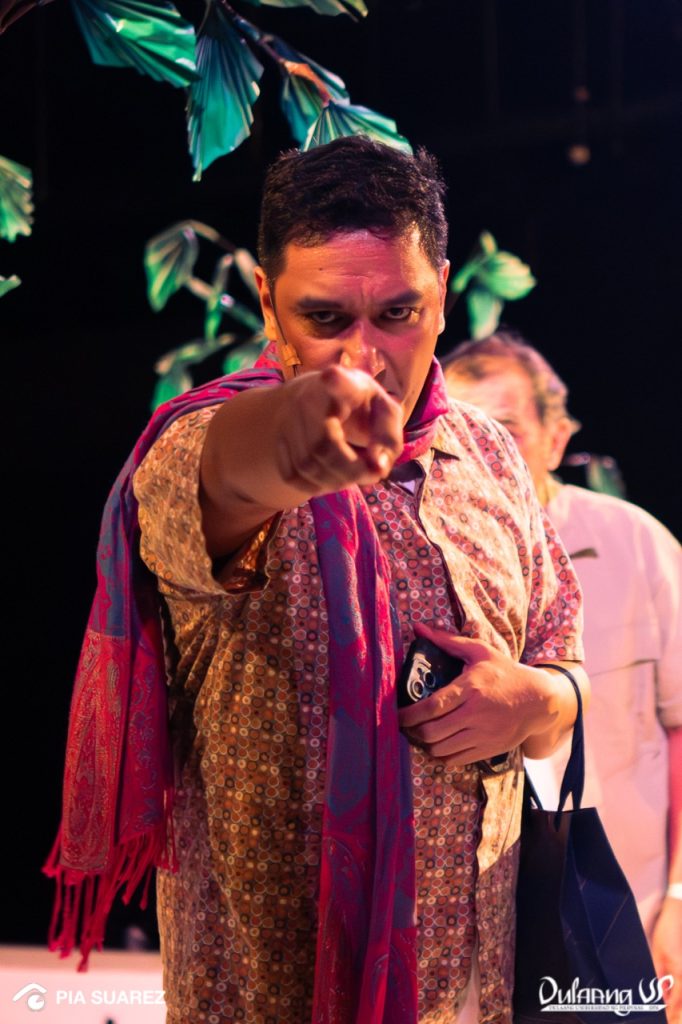
    Dulaang UP Ang Kaliitan ng Kasalukuyan 16
    Dulaang UP Ang Kaliitan ng Kasalukuyan | Photo by Pia Suarez

    And all throughout the second act, we are presented with Bulan’s struggle. How his identity has been stripped away by family obligations, trapped in a foreign land that discriminates against him, away from home. Yet, the final song is a big, epic song that talks about how OFWs will continue to sacrifice their own happiness for their loved ones, for their country. These two ideological principles never feel settled by the play, and I left the IBG-KAL Theater a little perplexed rather than inspired.

    My Rating: 2 Stars

    stars 2 0


    While its run concluded in March, follow Dulaang UP‘s official social media channels to stay updated on future productions and the continued evolution of Philippine university theater.


  • OFW Realities Mirrored Through Theatre in Dulaang UP’s Ang Kaliitan ng Kasalukuyan

    OFW Realities Mirrored Through Theatre in Dulaang UP’s Ang Kaliitan ng Kasalukuyan

    For many different reasons, Overseas Filipino Workers (OFWs) courageously make a living abroad for years and oceans away from their loved ones. Most venture far in high hopes of greener pastures for their families. They confront homesickness, loneliness, culture shock, language barriers and (frustratingly) even racism in their everyday lives. Our migrant workers endure this altogether as they are driven by the struggle of life in the homeland.

    DUP AKK Poster March 2 IG Ratio

    Deemed as the country’s “modern day heroes”, their remittances play an integral role in the economy. There is then a strong sense of dependence by the government on the taxes collected from our “heroes”. Sensibly, one might expect that currencies entering the country would elevate the collective Filipino way of life, but that is not the case even after decades of waging OFWs.

    Their presence (or absence) has been normalized. It has become routine to see them out to the airport and greet them with Duty Free goods — often every Christmas or New Year’s season. Before leaving the country, they treasure moments at home as best as they can through feasting, meaningful conversations, and nostalgia walks. As they prepare to leave again, they take memorabilia and a new set of memories to sustain them in their workplace. 

    The solution to this cyclic and systemic problem is often grazed upon. Although media representations of their narratives are well-documented and shared through films, news broadcasts, social media sites, and television series, the conversation is lacking in the space of theatre.

    Dulaang Unibersidad ng Pilipinas (DUP) aims to offer treatises in filling this void. Their production in the works, Ang Kaliitan ng Kasalukuyan, was written and directed by Don Carlos Palanca Memorial Awards for Literature multi-awarded playwright and DUP Artistic Director, Arlo Deguzman. A returning alumni, not only does he head home and pay his services forward to his alma mater, but also picks up where he left in the country having been a migrant worker himself for almost two decades across fifty countries.

    Written from a place of diasporic experience, the piece is a powerful and contemporary work that tackles the emotional landscape of and an ode to our OFWs. These stories, embodied in movement and lyric, aim to negotiate the melancholically veiled struggles of a migrant worker: a father’s frustration from unending remittances, a mother seeking to make the sacrifice worthwhile, a sister negotiating the promise of separation, and a son bearing the silence of a deafening burden. DUP invites us to contemplate on our origins and bids for connection and home.

    Perhaps this allows you to ponder on life in the Philippines or abroad and would lead you to questions or answers sought after. You might even find comfort in knowing some of the cast and crew had been an OFW, had thought (or is thinking) of being one, or longs for a loved one abroad. Whether you are an OFW or not, a story relative to yours will be told live through theatre that will certainly evoke in you a sense of yearning. 

    With the increasing tensions around the globe, the safety of our OFWs is then at risk — it is Dulaang UP’s hope that fellow countrymen be home safe, live and labor in their homeland with dignity and justice. Ultimately, for that time where all Filipinos are happy at home, without needing to leave, could come.

    The production will run from March 12, 2026 to March 29, 2026 at the IBG-KAL Theater, UP Diliman; Thursdays and Fridays at 7:30PM, and Saturdays and Sundays at 2:30PM and 7:30PM. Tickets are available via https://bit.ly/AngKaliitanNgKasalukuyan2026 with the following prices:

    • 1,000 PHP Regular Price 
    • 800 PHP PWD / Senior Citizens / Non-UP Students
    • 700 PHP for OFWs—current and former, ticket is transferable; available via direct purchase
    • 650 PHP UP Community (Students and Employees): Friday–Sunday shows; available via direct purchase
    • 550 PHP UP Community (Students and Employees): Thursday shows; available via direct purchase

    Note that discounts/promos are not stackable on each other. 

    Meta: facebook.com/DulaangUnibersidadNgPilipinas/
    Instagram: instagram.com/dulaang_up/
    TikTok: tiktok.com/@dulaang_up